Contents
Besides the classical game, there are many other variants of this ancient game. Most of them are not as popular as classical chess, but they have their followers in particular countries and cultures. Today about 30 variants can be distinguished, each with its own features, board shape, number of players and rules. Let us look at the most popular ones.
Classical chess
The game is played on a square board of 64 squares (8×8), coloured alternately dark and light (in a “chequered pattern”). As a rule, two opponents play, each with 16 pieces of set value: 8 pawns, 2 bishops, 2 rooks, 2 knights, 1 queen and 1 king. Before the game the pieces are lined up in a fixed order on the two ranks nearest each player.
Battle chess
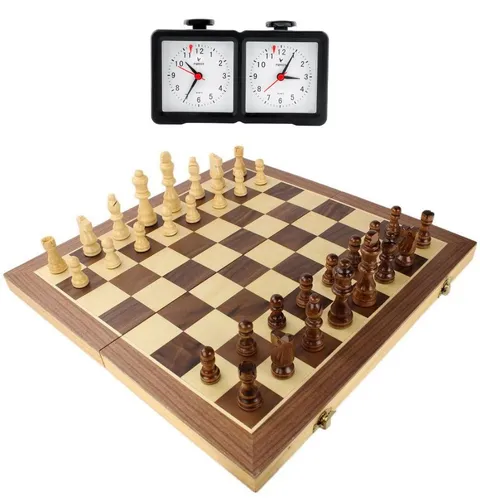
Before the game the opponents, on separated halves of the board and hidden from each other, set up their pieces however they like. The number of pieces is the same as in ordinary chess, but each piece may occupy any square in its own half of the board (the 4 ranks nearest the player), as the player wishes. In particular, a pawn may stand on the rank nearest the player, several pawns may be placed on one file, bishops may stand on squares of the same colour, and so on. After setting up, the opponents push the half-boards together and play by the ordinary rules, with a few exceptions:
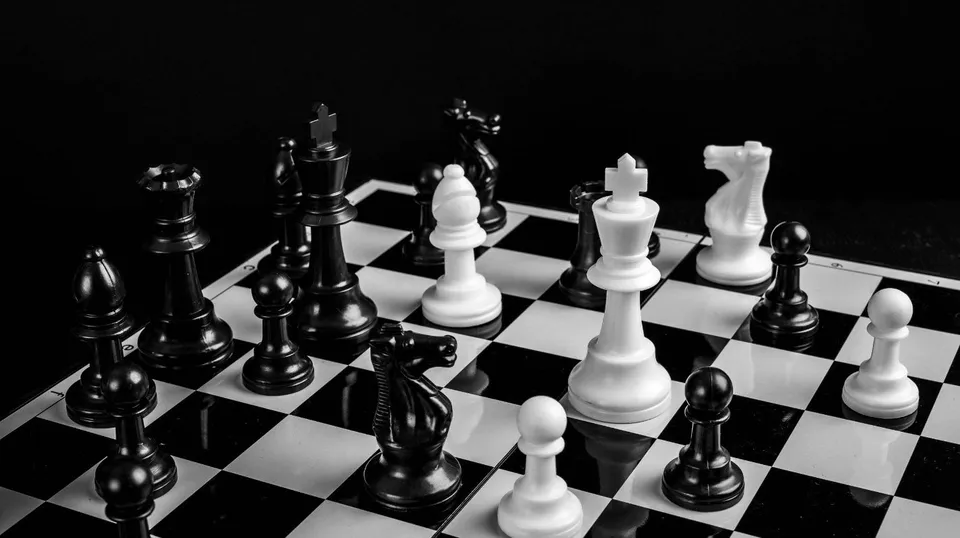
During set-up it can happen that at the moment of the first move one player's king is in check while, by lot, the opponent has the move. In that case the player whose king is in check loses. This slightly limits the number of starting positions, but it is rare and happens mostly to beginners.
When a pawn moves from the rank nearest the player (in notation, from the 1st or 8th rank), it may only go to the 2nd (7th) rank, after which it gains the right to move two squares forward, as in ordinary chess. In that case, with an enemy pawn suitably placed, the en passant rule can apply.
The rules were devised by G. M. Mironov. The federations of classical chess have not yet commented officially on battle chess.
There is an online portal where battle chess can be played. It regularly holds individual and team tournaments, some of which have had more than 200 participants.
Fischer Random chess
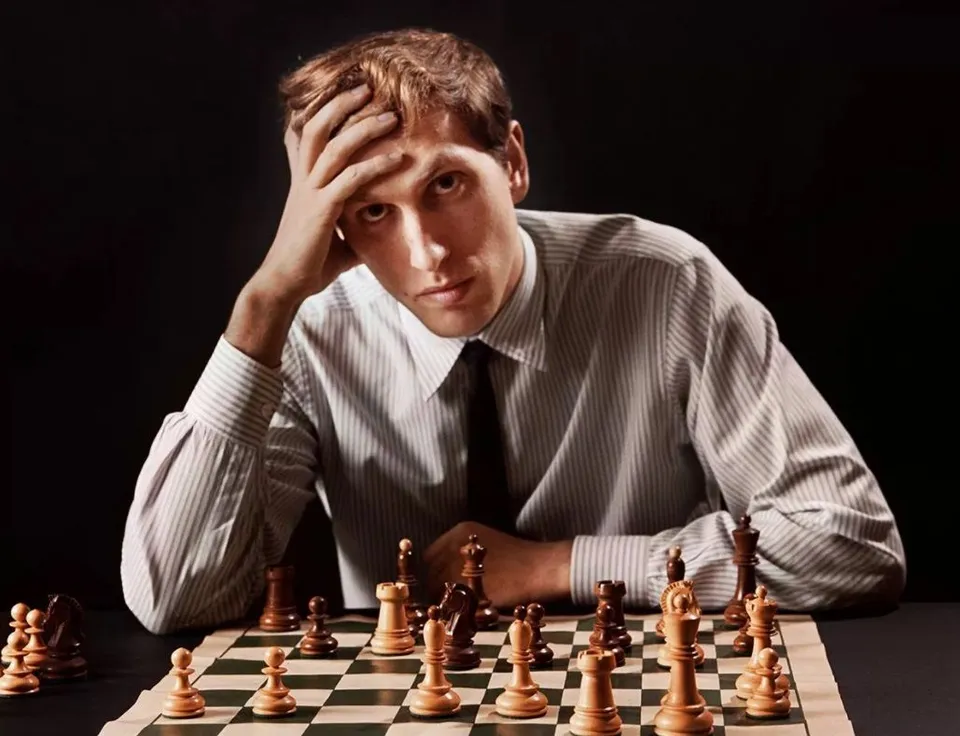
After retiring from active play, Robert James Fischer left his mark with a couple of interesting innovations: his own chess variant and his chess clock. Fischer Random differs from classical chess only slightly, but fundamentally — in the starting position. The board is standard, and the pawns stand as in classical chess, but the pieces are arranged on the first and last ranks in different ways.
The point is that in this format opening theory loses its value completely.
In Fischer Random there are three conditions for the set-up:
- The bishops must stand on squares of opposite colours.
- The rooks must stand on either side of the king.
- Black's set-up mirrors White's.
There are 960 such possible set-ups in all, which is why Fischer Random has another name — “Chess960”.
Similar ideas had appeared before. David Bronstein, for example, proposed and promoted something similar, but without conditions 2 and 3.
Nevertheless, it was Fischer's version that became relatively popular — evidently the champion's unquestioned authority played its part.
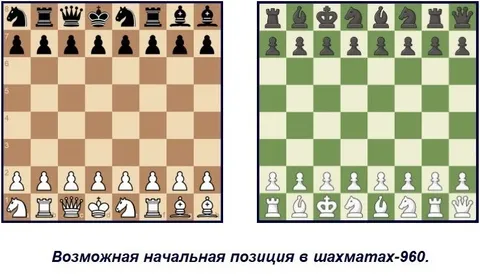
At first Fischer's idea was that both players set up their pieces as they wished.
Later, however, symmetry was made compulsory. In tournaments the starting position is generated by a computer before each playing day or round, and all games are played from the same position. Sometimes the number of possible positions is limited in advance to 20–50. The castling rule is also original. In Chess960 the moves are the same as usual — the exception is castling.
Wherever the king and rook stood, after castling they end up on the same squares as in ordinary chess: with short castling the king on g1 and the rook on f1.
Short castling uses the rook to the right of the king. With long castling the king goes to c1 and the rook — the one to the left of the king — to d1. That is for White; for Black the rule is the same. If the king already stands on g1 or c1, only the rook moves. If the rook already stands on f1 or d1, only the king moves.
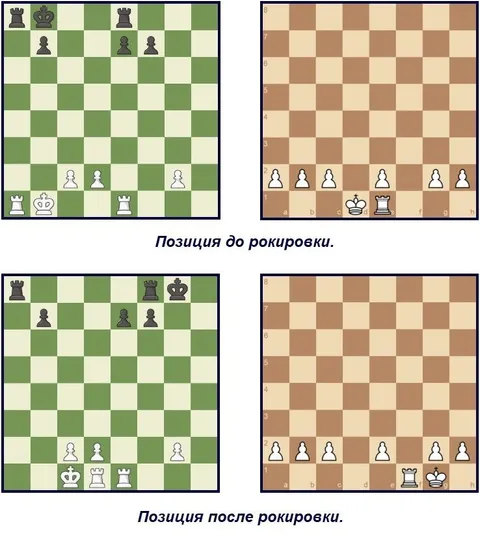
Hence one more difference from classical chess:
Castling may begin with the rook, or the king and rook may be moved at the same time. The move counts as made when the clock is pressed. The restrictions are: the squares the pieces land on after castling must be free, and all squares between the starting and final squares of the king and rook must be free.
The other rules are the same as for castling in classical chess.
Grandmaster tournaments in Fischer Random began at the turn of the 20th and 21st centuries, in the German city of Mainz.
Circular chess
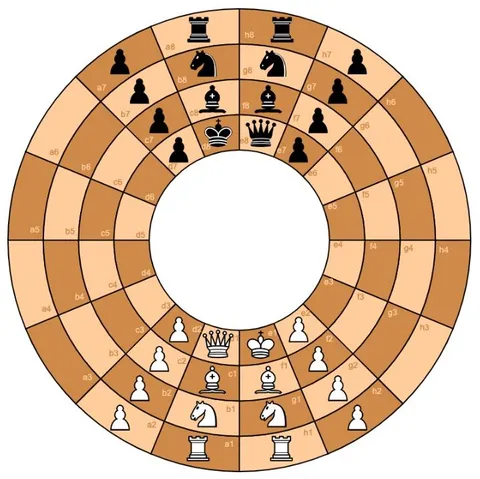
Circular chess is based on “Byzantine chess”, or zatrikion — a board game on a round (ring-shaped) board that was popular among the Byzantine nobility in the 11th–15th centuries. One set of rules for medieval circular chess comes from the “Treasury of Sciences” of the Persian writer Muhammad ibn Mahmud Amuli (1325). In this version, called shatranj al-muddawara (round chess) or shatranj ar-rumiya (Roman or Byzantine chess), the board has four concentric rings, each divided into 16 cells — 64 squares in all. In algebraic notation the four rings are lettered A–D and the cells in each ring numbered 1 to 16. The game is played by two players with 16 pieces each, White and Black, and the aim is the same as in ordinary chess — to checkmate the opponent's king.
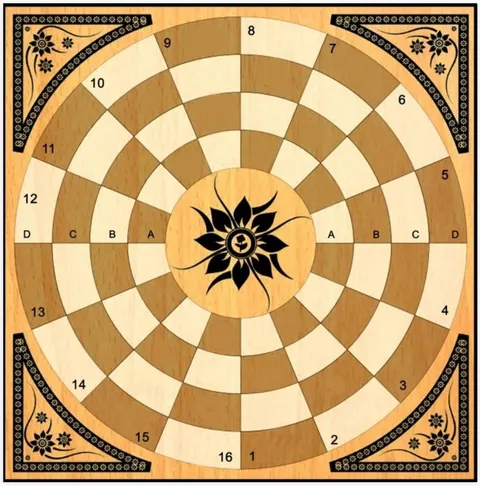
Byzantine chess had special rules, and perhaps for that among other reasons zatrikion came to be seen as old-fashioned and was gradually forgotten. The modern version uses the moves of the classical game. It was only in 1983 that the British historian David Reynolds, studying historical sources, came across a mention of Byzantine chess. He saw a picture of the game and was utterly charmed by it. Since he had no rules, he used the standard ones. After experimenting with various layouts, Reynolds built a board based on the picture and, taking a set of pieces, brought the game to a local pub in Lincoln, where he invited his friends to play.
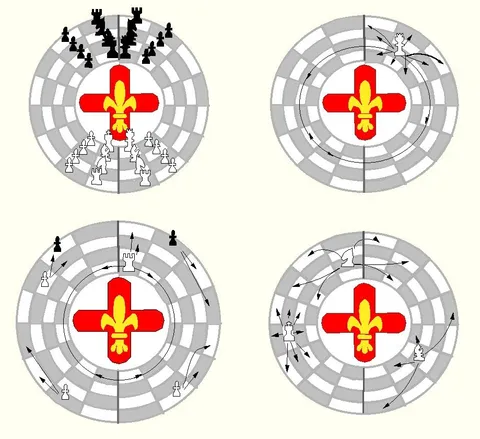
The players soon realised that round Byzantine chess is no less fascinating than ordinary square chess, while offering a completely different set of problems and possibilities. So began the history of circular chess. From 1996 annual tournaments were held in Lincoln, and in the 2000s the game gained international recognition. Annual world championships are organised by the British Circular Chess Society, founded by the same David Reynolds. The society's page: https://www.chessvariants.com/organizations.dir/circsoc.html
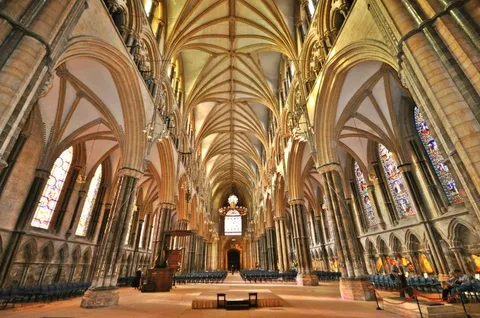
In 2005, the day after filming of “The Da Vinci Code” finished at Lincoln Cathedral, the society was given permission to use the cathedral as a tournament venue, which drew extra attention to the game.
The pieces move as in orthodox chess; a queen or rook may, if unobstructed, travel any distance around a ring, except that a “null move” — going all the way round the board back to its starting square — is not allowed. A pawn promotes after travelling six cells from its starting position, on the cell just in front of the opponent's starting line. Castling and en passant are not allowed. Announcing check is not compulsory, and “bagging” is allowed (winning at once by capturing the opponent's king after it has moved into check or failed to get out of check) — this has decided world championship games more than once.
In 1996 the Circular Chess Society held its first world championship: Robin Stevens became the first world champion after a tournament with about 30 participants.
The second world championship was held on Sunday 25 May 1997 in Lincoln, UK. Francis Bowers became the second world champion.
The third world championship took place on Sunday 17 May 1998.
The 2000 Circular Chess World Championship was held on 14 May 2000 at St Mary's Guildhall, Lincoln, UK.
The Circular Chess Society sends its members a newsletter called “Chess Nuts”. Membership costs £5 a year, worldwide.
Cylinder chess
A variant in which the board is shaped like a cylinder. There are the following kinds of cylinder chess:
• the vertical cylinder;
• the horizontal cylinder;
• a board rolled up in both directions.
Under these rules the a- and h-files (or the 1st and 8th ranks) are adjacent on the board, so pieces can move straight across from one edge to the other.
If ordinary chess came down from antiquity as a model of a battle of intellects, cylinder chess is a model of battle in an age of frantic globalisation!
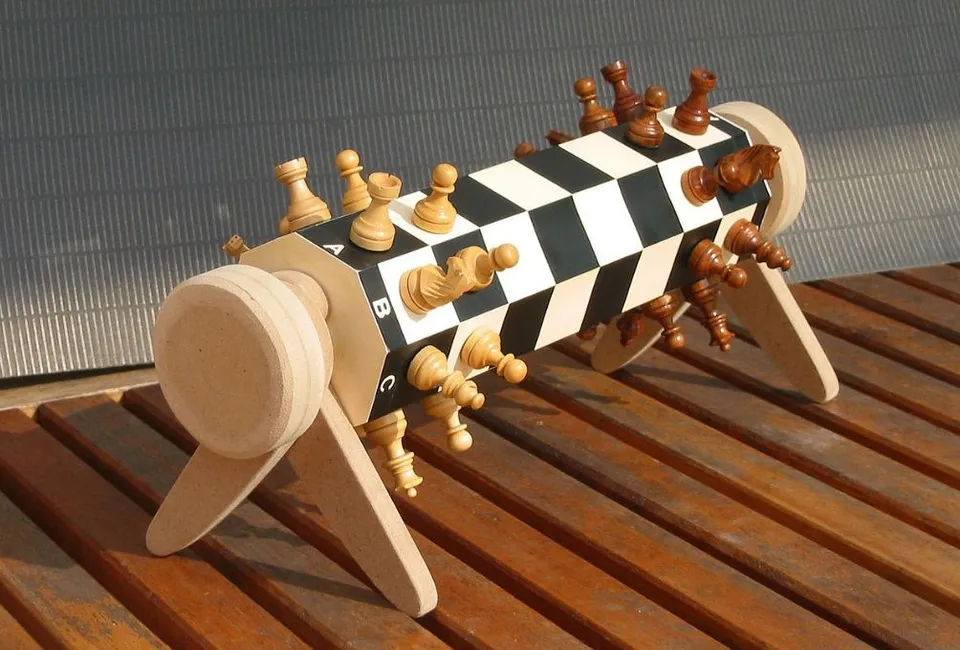
Normally chess takes place on a flat board. But with various geometric transformations an ordinary board can be turned into boards of the most surprising shapes. Of course, to compose and solve problems you need no scissors or glue — the transformations are easy to carry out in your head.
Chess on cylindrical boards is especially popular with composers of fantasy chess problems. A standard board gives two cylinders: a vertical one when the vertical edges are glued together, and a horizontal one when the horizontal edges are glued…
Cylinder chess was very popular in the first half of the 20th century. The vertical cylinder is made by joining the a- and h-files, the horizontal one by joining the 1st and 8th ranks. A combination of both is called an anchor ring, or torus. Of all the kinds of cylinder chess, the vertical cylinder has become the most popular.
Hexagonal chess
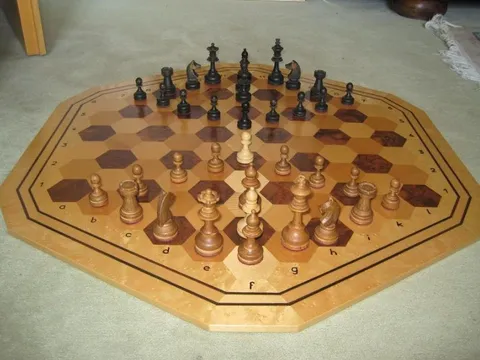
In this game the board is a regular hexagon made up of 91 hexagonal cells in three shades. The set of pieces is the same as in the traditional game, but each player has an extra bishop and pawn. The pieces move much as in classical chess, taking into account the hexagonal shape of the cells.
The first version of hexagonal chess was devised by Lord Baskerville in 1929; it used a rectangular board of 83 cells. The most popular version was created in 1938 by Władysław Gliński.
In the early 1970s Gliński refined the game and in 1973 patented the version now accepted as final. In the same year the specially founded publisher Hexagonal Chess Publications published the final rules. Hexagonal chess began to spread from Poland and England, where it quickly became popular. In 1976 the British Hexagonal Chess Federation (BHCF) was founded and the first championship was held. Gliński's visit to Poland in 1978 and its press coverage boosted interest in the game in Eastern Europe; more than 90,000 sets were sold in 18 months.
In 1980 the International Hexagonal Chess Federation (IHCF) was founded.
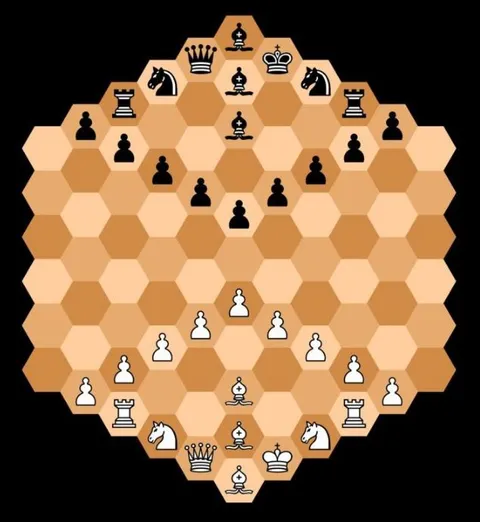
Gliński's chess is played on a board in the shape of a regular hexagon with 91 hexagonal cells. The set is the same as in classical chess, with one extra bishop and one extra pawn for each side. The rules can be thought of as the same as in classical chess if the slanting lines parallel to the non-vertical sides of the board are taken as ranks, and lines of same-coloured cells as diagonals.
Russian chess (tavreli)
In this variant the pieces move no differently from classical chess, but their names are completely different. The pieces are called tavreli and stand on the board in exactly the same order. The main piece is the helgi, which combines the powers of the queen and the knight. In Old Rus this kind of chess was widely played in the 9th–10th centuries, but later the Church banned it, equating it with drunkenness and gambling.
Tavreli disappeared completely under Peter the Great, who decided to popularise classical chess in Russia. In 1997, however, the International Russian Chess Federation was founded in Moscow, updated rules were established and the first competitions were held.
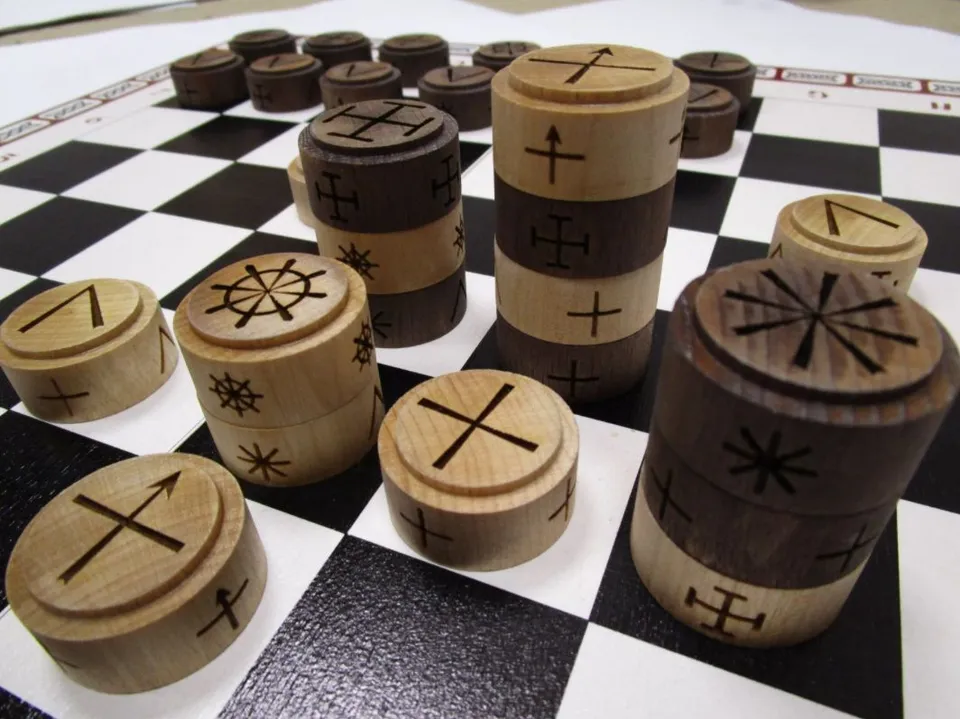
Only recently, thanks to the efforts of the Moscow Assembly of Nobility and the Foundation for the Support of Creative Personality, has Russian chess begun to develop rapidly. In 1996 a project to revive Russian chess was considered and adopted at a meeting of the State Commission for the 850th anniversary of Moscow, chaired by Mayor Yuri Luzhkov. In 1997 the International and Interregional Russian Chess Federations were founded. Their president was V. A. Ivanovsky, head of the Moscow Assembly of Nobility, and the vice-presidents were world champion A. E. Karpov and G. L. Sterligov. A great deal of work was done to collect, systematise and summarise all the archaeological and historical information about tavreli. As a result, modern rules of Russian chess were developed and patented, and a programme for developing Russian chess until 2000 was prepared and approved.
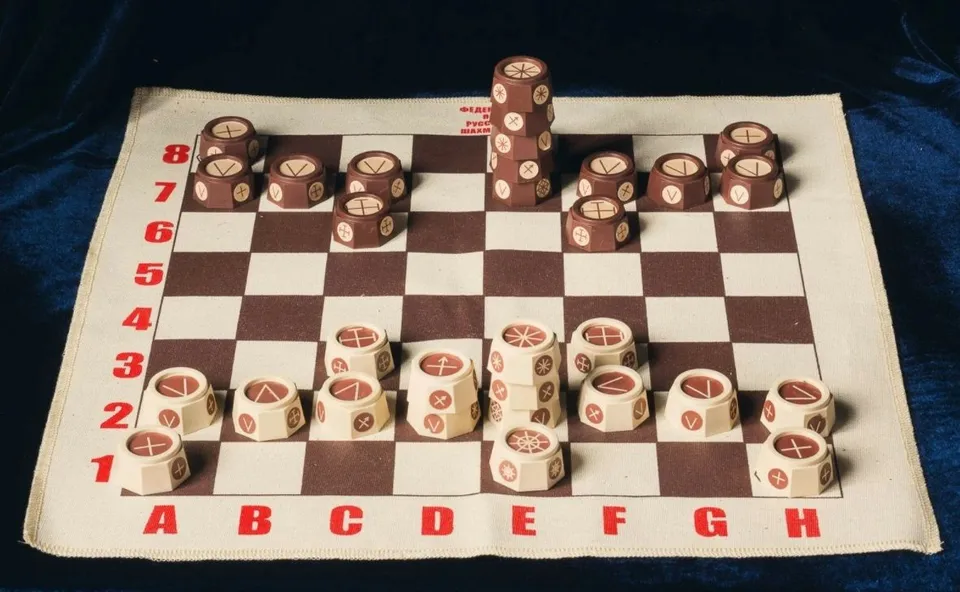
The federations organised two Russian men's championships (Ryazan, 1996; Smolensk, 1998), an international tournament as part of the official programme for Moscow's 850th anniversary (September 1997), an exhibition tournament for participants of the World Youth Games (Moscow, July 1998) and the First International Children's Tournament (Smolensk, December 1998). Children's schools opened in Moscow, Smolensk and Tula, and an All-Russian methodological centre was set up. There are regional branches in Moscow, St Petersburg, Tula, Smolensk, Ryazan, Perm, Yaroslavl and Krasnoyarsk.
In 1999 seven national and international competitions were held, including the Second International Grandmaster Tournament and the First Russian Women's Championship. Special attention is paid to children's chess: plans include opening children's schools, holding training sessions, publishing textbooks and training coaches.
Society website: https://www.rus-chess.ru
Russian line chess
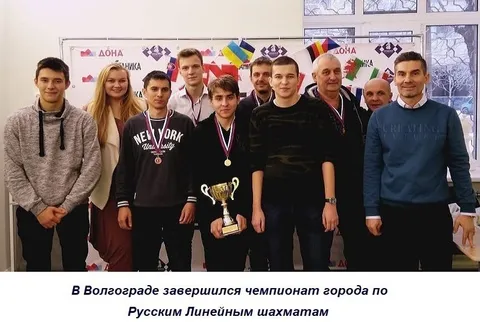
A player may have several kings. The board is divided into vertical lines, each starting at a white piece on one side and ending at the corresponding black piece on the other. When a piece lands on another piece's line, it turns into the piece whose line it is on. The aim of Russian line chess is not checkmate, since a player can obtain another king by moving onto the king's line. The game appeared fairly recently; its founder is considered to be the writer Valery Danilchuk. The first official tournament was held in 2018 in Volgograd.
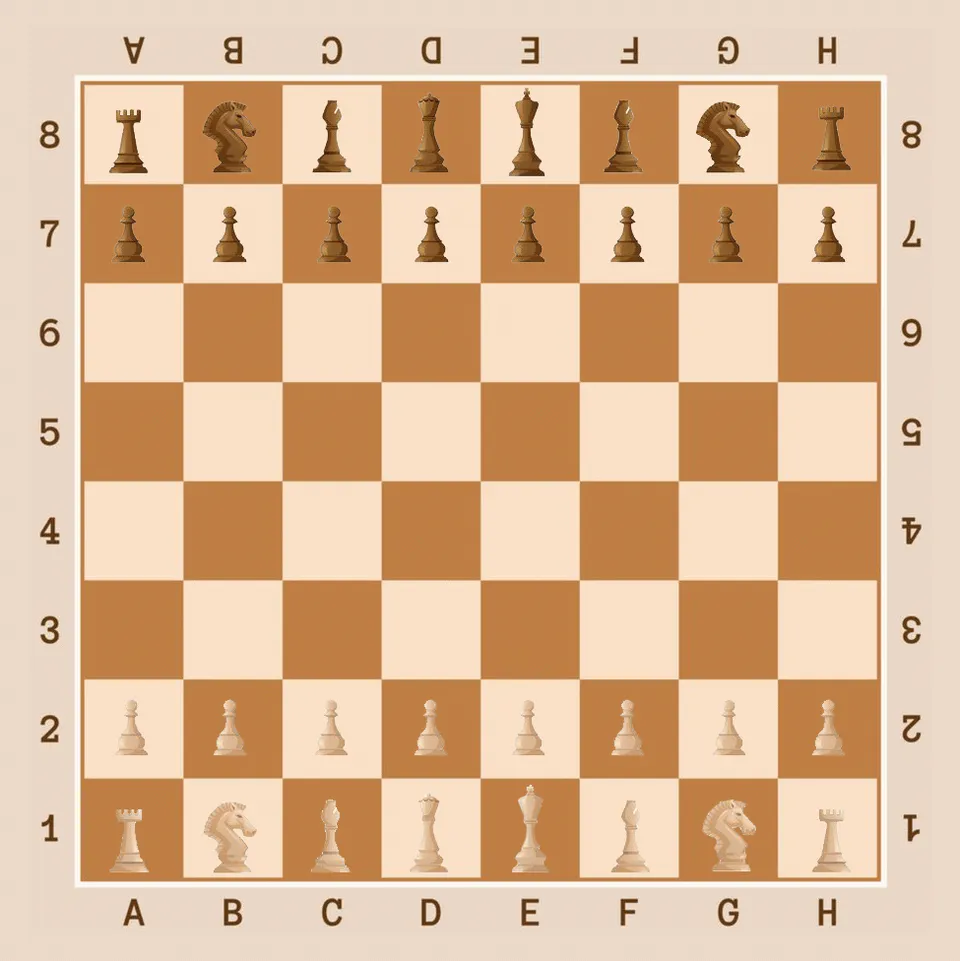
Pawns and pieces move as in classical chess.
The board is visually divided into lines (files). Each line starts at a white piece and ends at the opposite end of the board at the matching black piece.
In Russian line chess a player may have several identical pieces (queens, bishops, knights, rooks) and several kings.
When a piece lands on another piece's line, it turns into the piece of that line. For example, after White plays the knight from g1 to f3, the knight lands on the bishop's line, turns into a bishop, and White now has three bishops.
Kings may approach and capture each other. If a king leaves its line when moving (or capturing), it turns into the piece of the line it lands on. If the player has no second king at that moment, the game is lost.
Checkmate does not count as a win, because a player in check or mate can obtain a new king on the next move by moving one of their pieces onto the king's line.
Victory is achieved by capturing the opponent's last king. A player left without kings loses. A player who moves their last king onto another line (or captures with the king a piece standing on another line) also loses.
Castling is possible only if the player has a second king on the board. After castling the king and rook turn into other pieces depending on the lines they land on.
On reaching the last rank, a pawn turns into the piece of the line it is on.
Xiangqi — Chinese chess
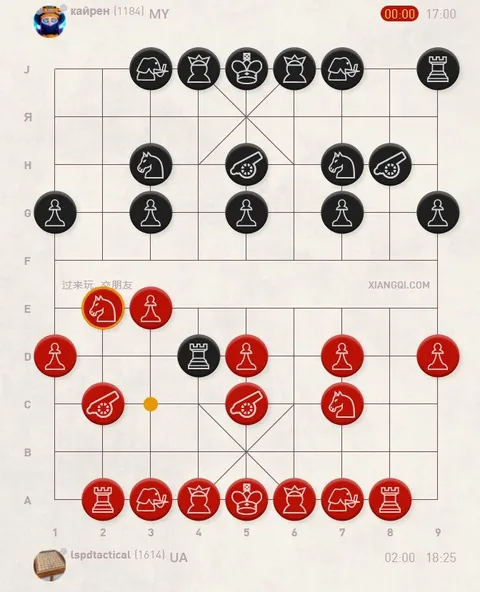
Xiangqi is often called Chinese chess. It is one of the most popular board games in the world and is played well beyond China, by hundreds of millions of people. Xiangqi was included in the World Mind Sports Games of 2008 and 2012. It resembles ordinary chess but has several important differences, including different pieces and moves. The aim, however, is the same: to capture the enemy general (king). In xiangqi you can also win by checkmating or by leaving your opponent without a legal move.
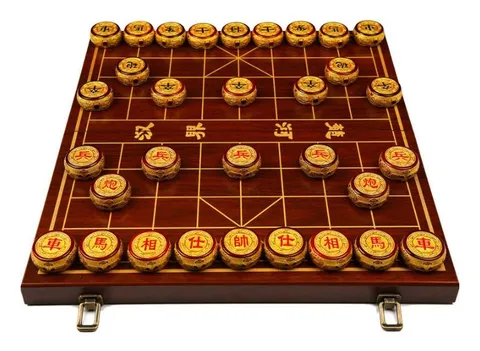
The board looks like a grid of squares, but in the middle a river divides it between the two players. In certain places there are also diagonal lines marking the boundaries that some pieces may not cross.
Some pieces cannot cross the river at all, while soldiers gain new powers once they have crossed it.
On each side of the board there is an imperial palace, which the general and his guards may not leave.
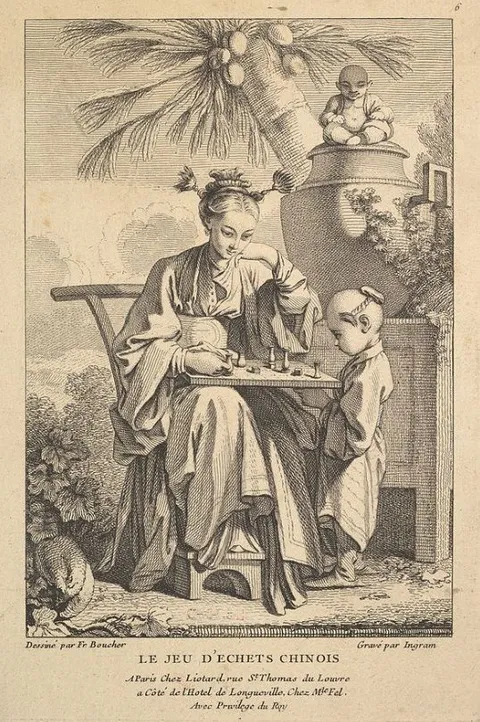
In xiangqi the pieces stand on the intersections of lines (called points), not on squares as in ordinary chess. The board has 9 points across and 10 along. As in the game of Go, the pieces move along the intersections of lines. The pieces are similar to those of ordinary chess: each player has one general (king), 2 guards, 2 elephants, 2 chariots (rooks), 2 horses, 2 cannons and 5 soldiers (pawns). The pieces are flat discs marked with red or black Chinese characters naming the piece.
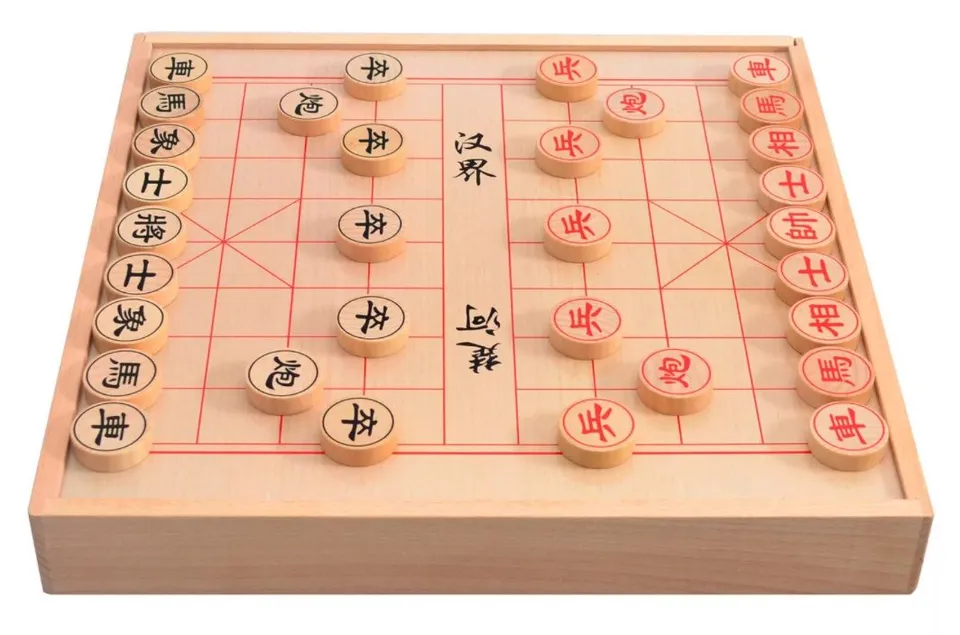
As in ordinary chess, each piece has its own starting place on the board, and before the game the pieces are set out in their places — remember that they stand on the intersections, not in the squares. During the game the players capture each other's pieces until one of them mates the opponent's general. Mate is declared when the opponent has no move to protect the general from check. Unlike in ordinary chess, a player who has no legal move at all (stalemate) also loses.
Play online: xiangqi.com
Sources:
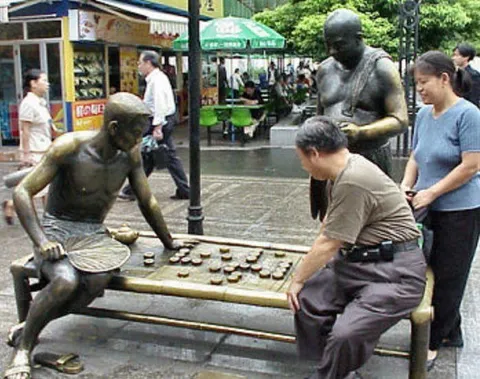
So, when playing Chinese chess it is important to balance defence and attack without getting carried away by either one; otherwise it is quite easy to lose. This fits well with Chinese philosophy and mentality: you can win even with small forces — you just have to use the resources you have wisely.
Shogi — Japanese chess
According to modern historians, shogi is a separate branch of the chess family. Neither the moment it appeared nor its original form is known exactly, but apparently in the second half of the first millennium AD shatranj, widespread in the Arab East, reached China, where it became the basis of xiangqi, and shogi in turn descended from that. The game's ultimate ancestor arose in ancient India. Shogi in its modern form became known in the 16th century. Today it is played by about 20 million people, and one of its greatest players is Yoshiharu Habu.
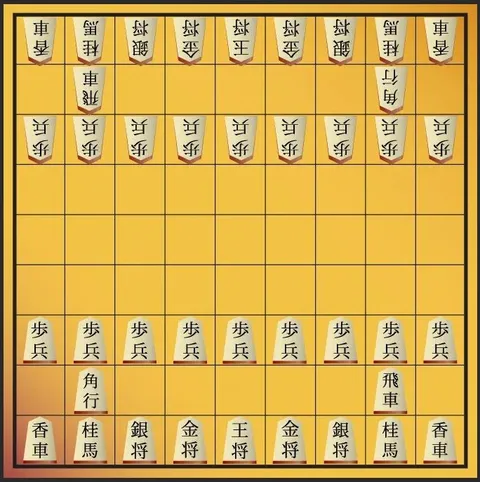
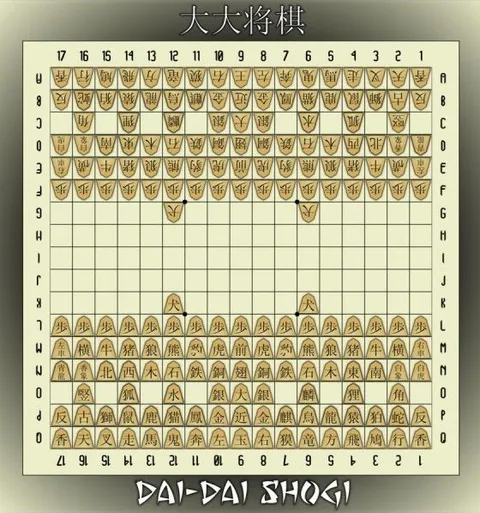
Over the centuries Japan also played larger forms of shogi:
Chu shogi — 12×12 board, 92 pieces.
Dai shogi — 15×15 board, 130 pieces.
Dai-dai shogi — 17×17 board, 192 pieces.
Maka-dai-dai shogi — 19×19 board, 192 pieces.
Tai shogi — 25×25 board, 354 pieces.
Finally, in the 16th century Emperor Go-Nara created the shogi known today. Taking as his basis “small shogi” on a 9×9 board, he reduced the number of pieces to 40 and introduced a fundamentally new rule: captured enemy pieces now passed to the capturer, who could at any time, instead of a move, drop any of them onto the board as his own. This innovation changed the strategy and tactics of the game radically, and it is really from this point that the history of modern shogi should be counted.
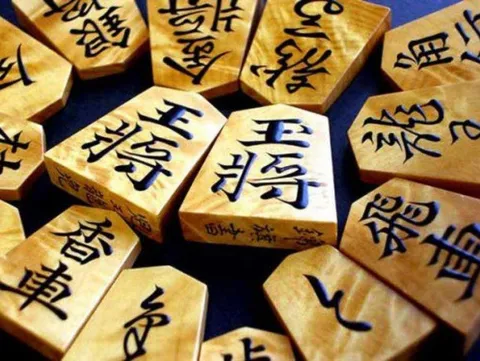
Play online: playok.com
Sources:
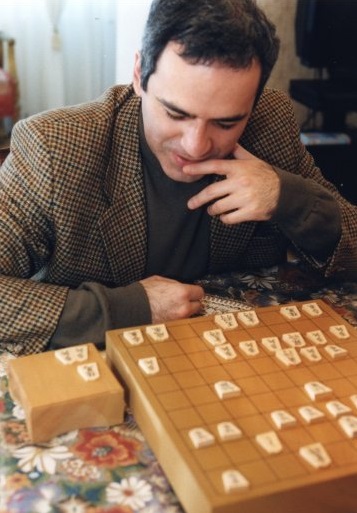
17 November is officially Shogi Day in Japan. In the Edo period, from 1669, a ceremonial game of shogi called the “Edo Castle game” was replayed every year on this day before the shogun (the game itself having been played beforehand between the strongest players).
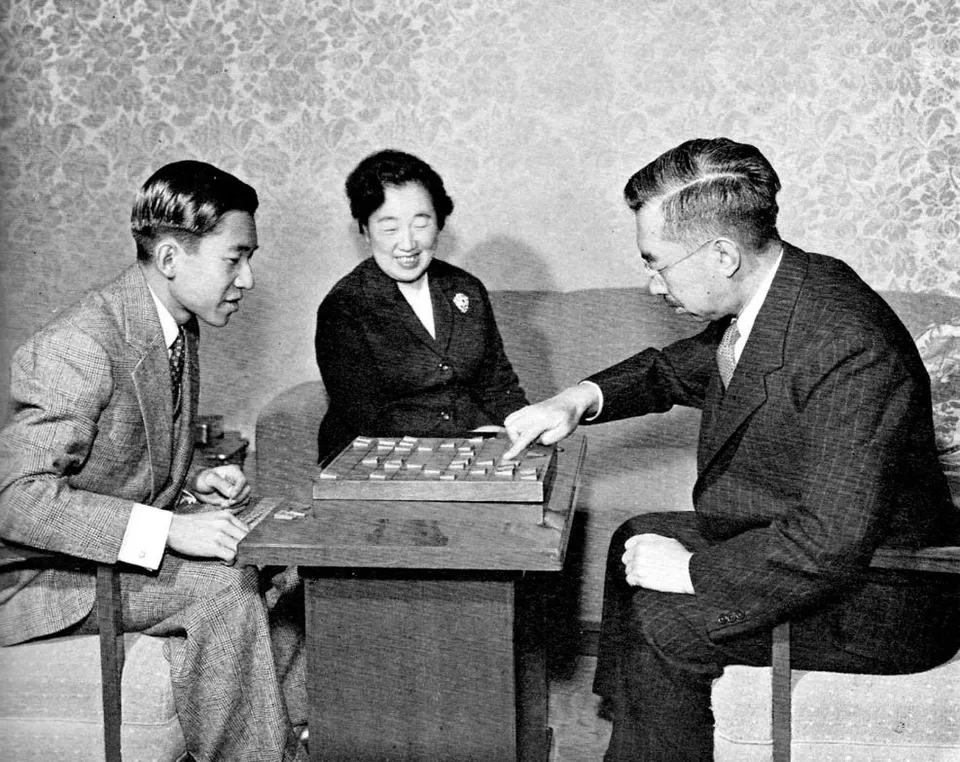
On 12 October 2010, after about 35 years of development, a computer finally beat a professional player: the best woman player, Ichiyo Shimizu, lost to the Akara2010 system in a game lasting just over 6 hours.
On 10 April 2016 the program Ponanza beat 8-dan professional Takayuki Yamasaki in 85 moves; Yamasaki used 7 hours 9 minutes of thinking time.
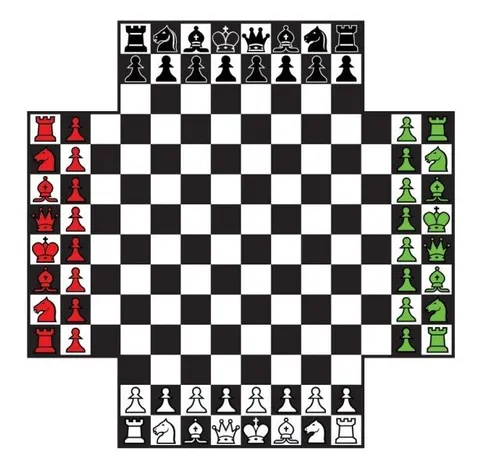
Three-player chess
Three-player chess is a special variant for three players using a special non-standard board, traditionally a hexagonal one. It keeps the basic rules of chess but has its own features. There are pieces of three colours — white, black and red. White occupies files A to H on the first two lines, Red files A to N on lines 11–12, and Black files H to N on lines 7–8. The pieces are arranged in the same way as in traditional chess.
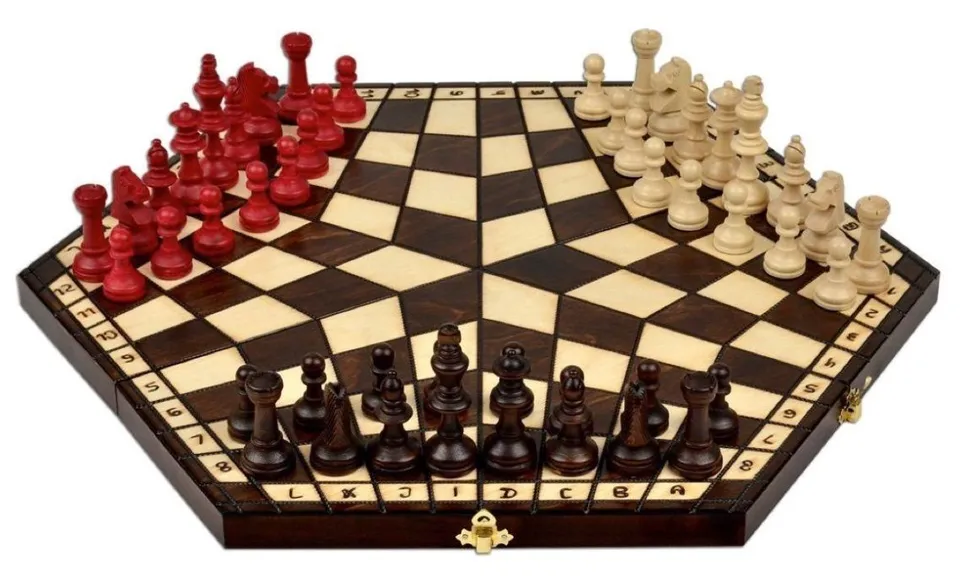
Colours are decided by lot. White moves first, then Red, and Black completes the cycle. The pieces are set up in the corners of the hexagon. Orientation on the board is helped by its intuitive division into zones and by each player's own colouring of the board. Play starts with White and goes round in a circle.
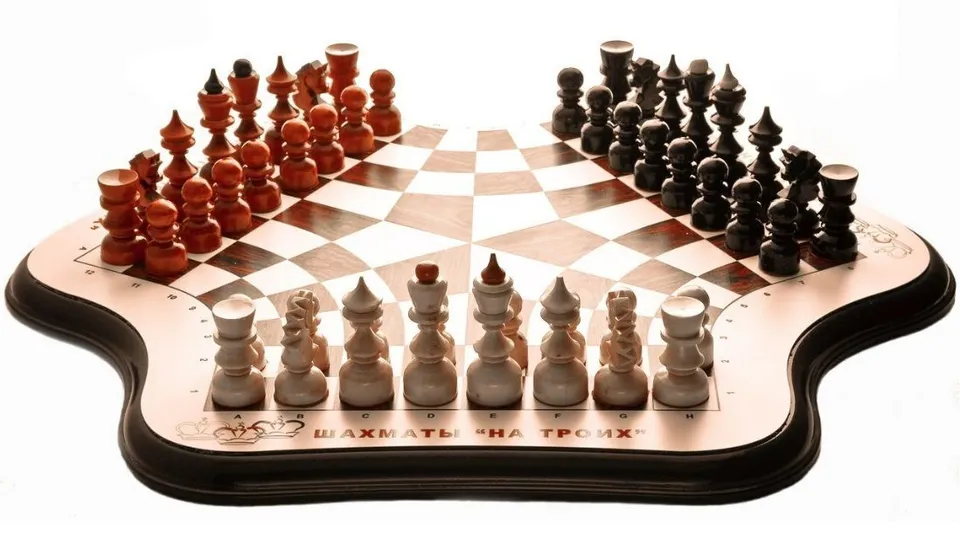
What makes it possible for weak players and grandmasters to play on the same board? In “Russian three-player chess” there are no traditional openings, and even a very experienced player has to use ingenuity to find a way out of a difficult and unfamiliar situation, thinking carefully not only about the overall strategy but about every single move.
Sources:
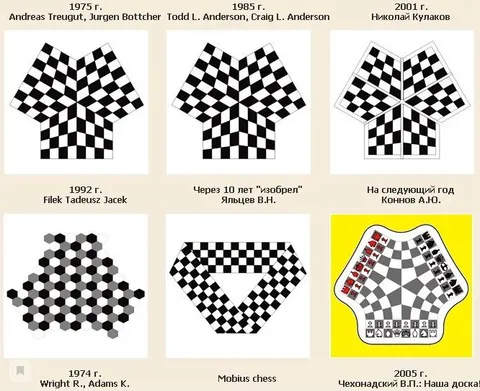
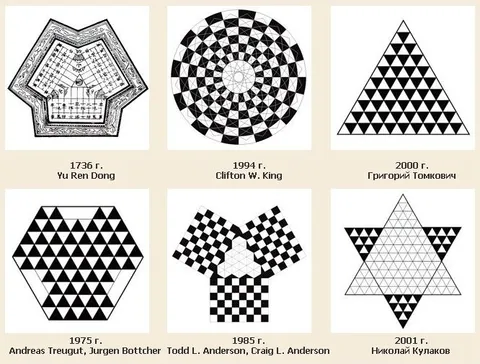
Three-player chess is a relatively new game with several kinds of boards; the hexagonal board is far from the only one. The rules for setting up the pieces and their number may differ slightly — for example, some boards provide for two extra pawns.
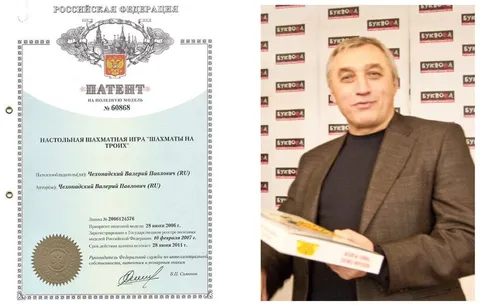
As even this far-from-complete list shows, the variety of chess variants is endless, and some differ from one another only slightly. Anyone can draw a new board; creating a complete variant that interests people and getting it produced is a much harder task — one that has been successfully solved for three-player chess.
Four-handed chess
Four-handed chess involves four players at once. The most popular is the German variant, with a board like the classical one enlarged by three extra rows on each side and four sets of pieces of different colours. Four-handed chess was already known in the second half of the 18th century at the court of Catherine II. In England the official rules were published in 1881 by Captain George Verney.
With four players, the pairs sitting opposite each other are allies whose aim is to checkmate both enemy kings.
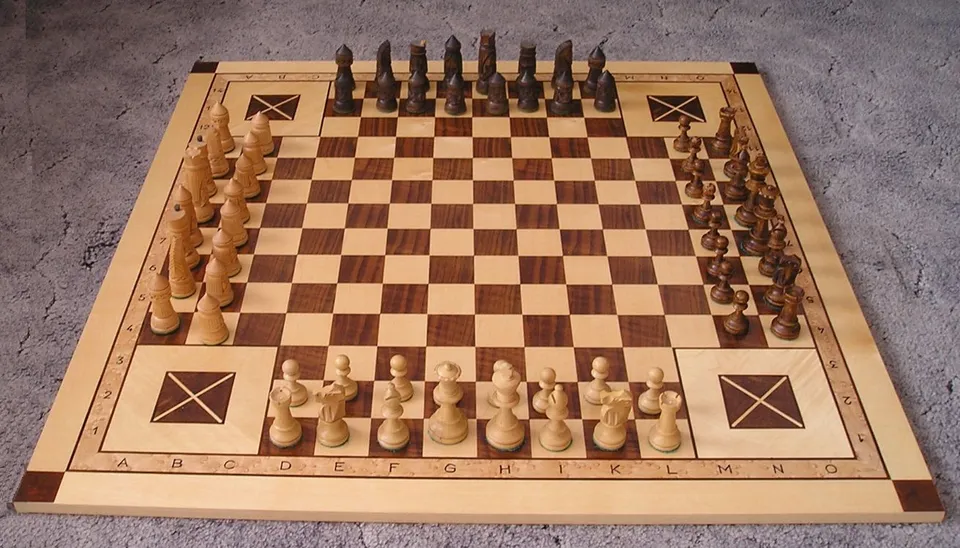
Two versions of four-handed chess were known in Russia: “German” and “Russian with fortresses”. In both, the allies sit opposite each other. They may not confer aloud but must act together. The pieces move as in classical chess. The European and Russian versions differ in board shape, number of pieces and pawn promotion rules, but the main difference is in the winning conditions. In the German game a checkmated king is not removed from the board, and its player is not declared defeated but is “taken prisoner”: their pieces stay on the board but cannot move until their ally releases the king from mate. To win under German rules you must mate both enemy kings. In the Russian game opponents can be eliminated one after the other: any mate means the final removal of that king and his whole army.
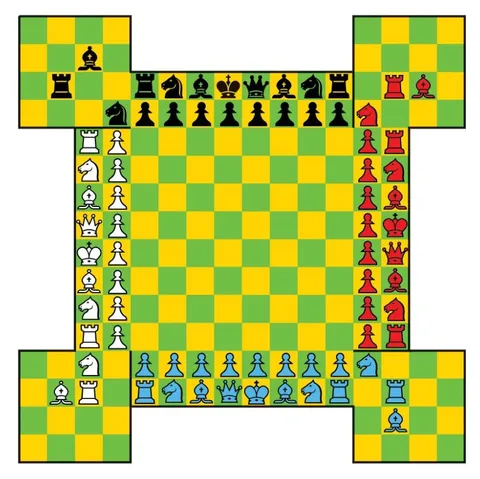
Alexander Petrov, one of the strongest players of the 19th century, criticised the German rules: in chess you sometimes sacrifice several pieces and even the queen to give mate — and here the mate you have given can be undone! In his view the German game was less interesting than the Russian one and had the further drawback that games lasted extremely long. Nevertheless, Russian four-handed chess did not hold its place in history. Today you cannot buy a set, there are no serious works on its theory, and the only source of information is Petrov's own article in “Shakhmatny Listok” No. 44, August 1862.
Play online: chess.com
Sources:
The European rules, on the other hand, caught on widely. A club of German four-handed chess enthusiasts was founded in London in 1885. The Russian grandmaster Mikhail Chigorin and the third world champion José Raúl Capablanca were fond of the game: many masters of the time studied unconventional systems while preparing a reform of classical chess, which in their view was threatened by stagnation and “draw death”. In the 1970s interest in four-handed chess grew in the USSR: three official championships were held in Moscow, and about 70 players received pair ranking titles.
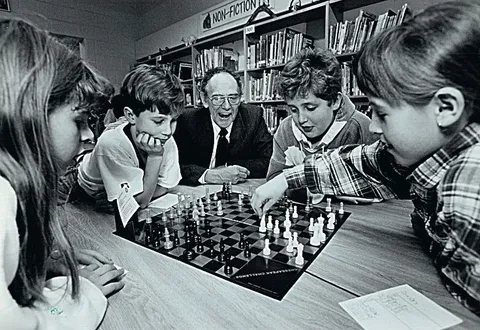
Much of what works in classical chess does not apply in four-handed chess; to win you have to learn everything anew. Such a dispersal of effort would probably hinder a serious player's professional growth, but for an amateur a battle under unusual conditions is a double pleasure.
German four-handed chess.
The rules were standardised and published in 1881 by the Englishman George Verney.
Bughouse (Swedish chess)
One of the variants for four players. The players form teams of two, and the game is played on two boards at once. Team-mates sit side by side at different boards, playing pieces of different colours. A piece captured from the opponent on one board can be passed to the partner playing on the other board, who can use it as their own. Bughouse is usually played with a short time control. Because of the fast moves and pieces passing between boards, people unfamiliar with the game think it is madness — hence its English name, bughouse, meaning “madhouse”.
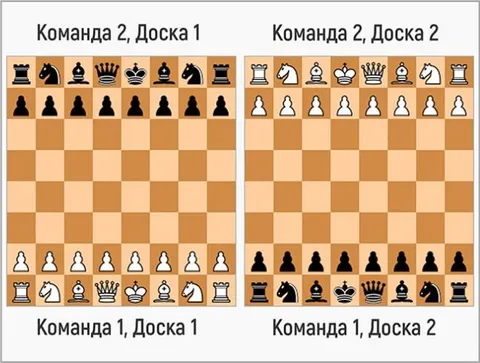
The game is played on two standard chessboards under the classical rules.
Two teams of two players each take part.
One member of each team plays White, the other Black.
The clocks are placed on the outer sides of both boards so that all players can see them.
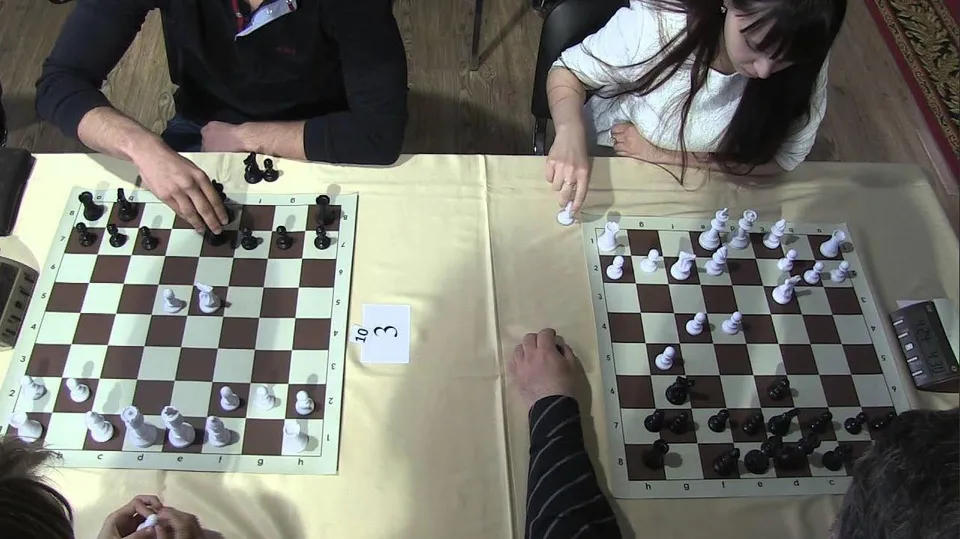
The losing team is the one that is checkmated on either board or whose time runs out first.
The move passes to the opponent only after the clock has been pressed.
Captured enemy pieces are passed to the team-mate and form their reserve.
A promoted pawn turns back into a pawn when it is passed on.
For convenience, a promoted pawn is not replaced by the new piece; its new value is simply remembered.
Pawns from the reserve may not be placed on the first or last rank.
A rook placed from the reserve on the first rank may take part in castling.
Reserve pieces must be visible to all players.
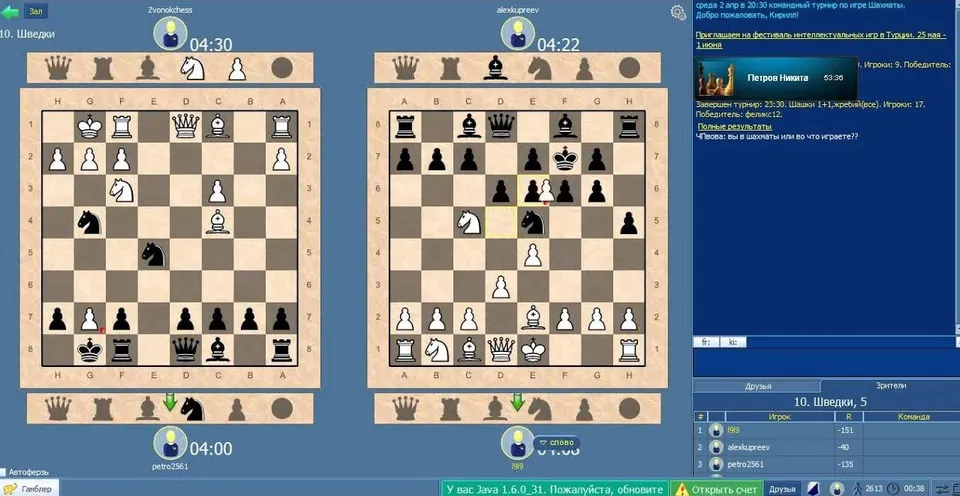
Sources:
A dropped piece may give check or mate (different rule sets restrict this in different ways).
If the king cannot escape check or be shielded by a piece on the board, but could be shielded by a piece from the reserve (even one not yet available), the position is not considered mate.
A player may “sit” and wait for the piece they need, for one side to win on the other board, or for time to run out.
If the king cannot be protected from mate by any permitted means, this is called “mate on the board”.
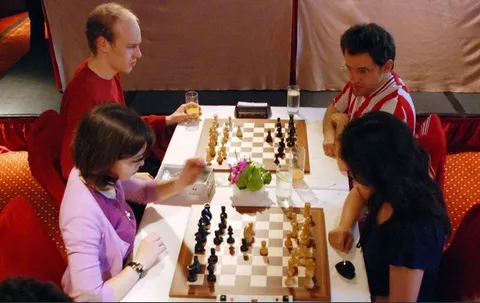
If a player finds themselves in a situation where continuing is unfavourable (no piece in the reserve to block a check, mate threatened next move…), they may “sit”. Their time keeps running meanwhile. This is used when the partner has more time or a more winning position.
Team-mates may talk during the game. Phrases like “Trade queens”, “I need a bishop” or “Mine is sitting” (meaning the speaker's opponent is waiting) are allowed. Hints about a specific move, such as “Play knight to e5”, are not.
Short time controls are usually used — 3–5 minutes per game for each player. If there is no clock, a “move for move” rule applies: a player who has moved on their board may demand that their opponent on the other board also make a move.
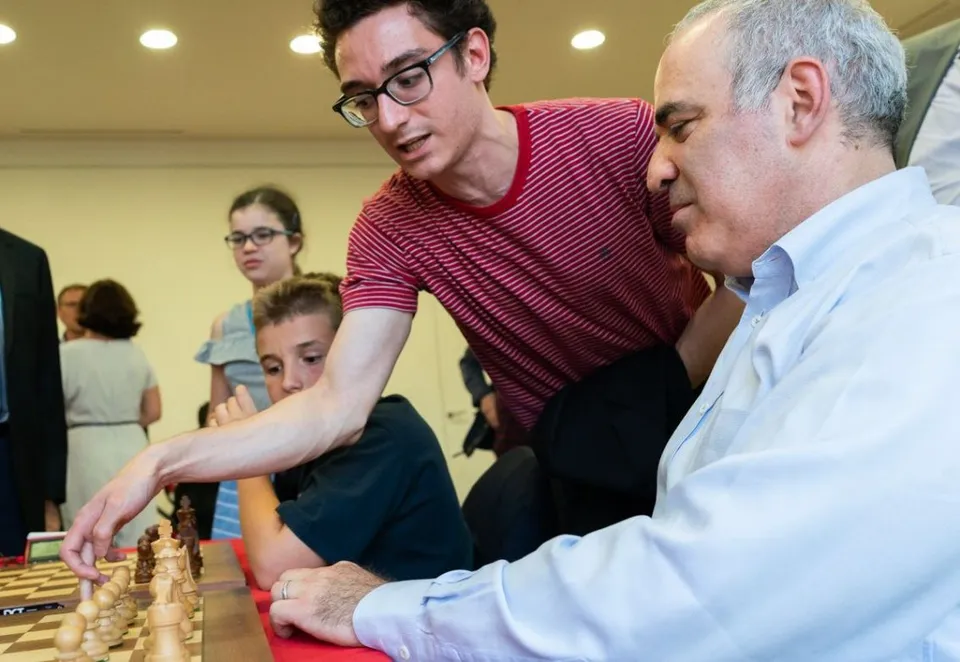
At the closing of a tournament in Paris, Kasparov played bughouse for the first time in his life.
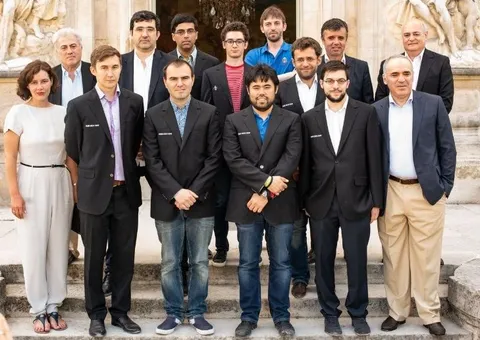
On the Monday of the closing event of the Paris leg of the Grand Chess Tour, the grandmasters, including Garry Kasparov, played in pairs with members of the international business elite. It was also announced that Magnus Carlsen would take part in the Sinquefield Cup.
The Château d'Asnières, in Asnières-sur-Seine north-west of Paris, hosted the stylish and fun final event of the Grand Chess Tour in Paris. That day all 10 grandmasters first gave simultaneous exhibitions (each against 10 amateurs), then came the closing ceremony and a special tournament in which professional players were paired with celebrity guests.
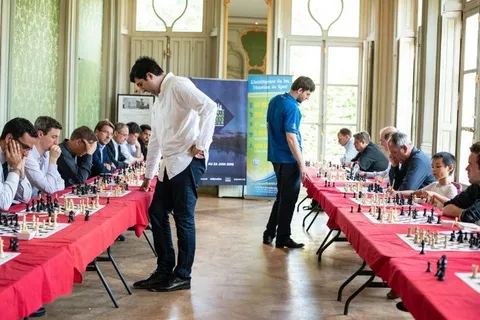
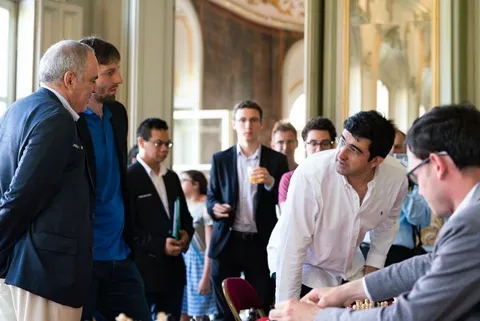
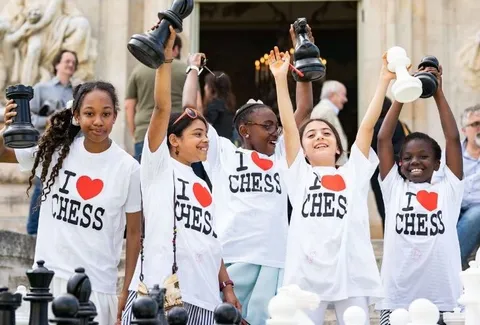
The tandem tournament featured 12 pairs of players and business people (the grandmasters who played in Paris, plus Garry Kasparov and Étienne Bacrot), split into two groups whose winners met in the final. Under the rules, the chess players and the business people had to take turns making moves. The time control was five minutes per game plus a two-second increment per move.