Contents
- There are several ancient legends about the origin of chess
- This is how the first legend goes
- Persian chess players
- Arab transformations
- Chess in East Asia
- Chess comes to Rus
- Chess reaches Europe
- Chess in art
- The Christian Church against chess
- The development of chess theory
- Chess in the 19th and 20th centuries
- Chess becomes an international sport
- Chess today
- Living chess
- The benefits of playing chess
The game has different names in different countries: chess in England, ajedrez in Spain, Schach in Germany, échecs in France. The Russian name, “shakhmaty”, comes from Persian: “shah” and “mat”, meaning “the ruler is dead”.
The history of chess goes back at least one and a half thousand years. It is believed that its ancestor, chaturanga, appeared in India no later than the 6th century AD. As the game spread to the Arab East, then to Europe and Africa, its rules changed. It took its present form by the 15th century, and the rules were finally standardised in the 19th century, when international tournaments began to be held regularly. So chess, invented in India in the 5th–6th centuries, spread practically all over the world and became an integral part of human culture.
There are several ancient legends about the origin of chess
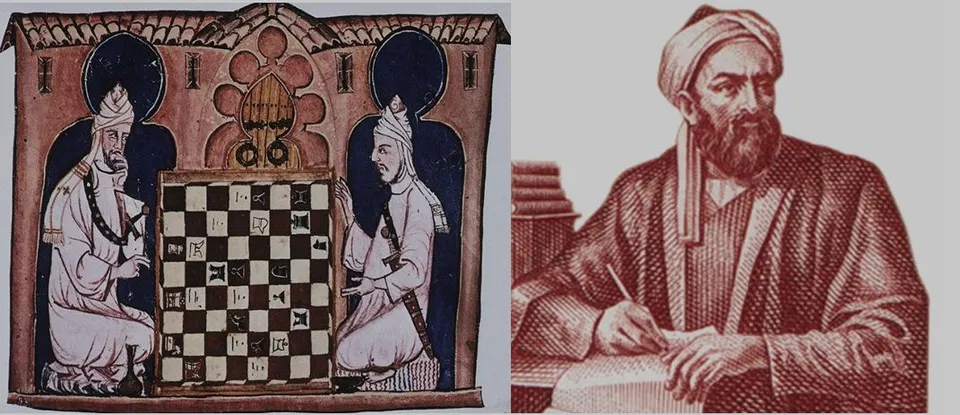
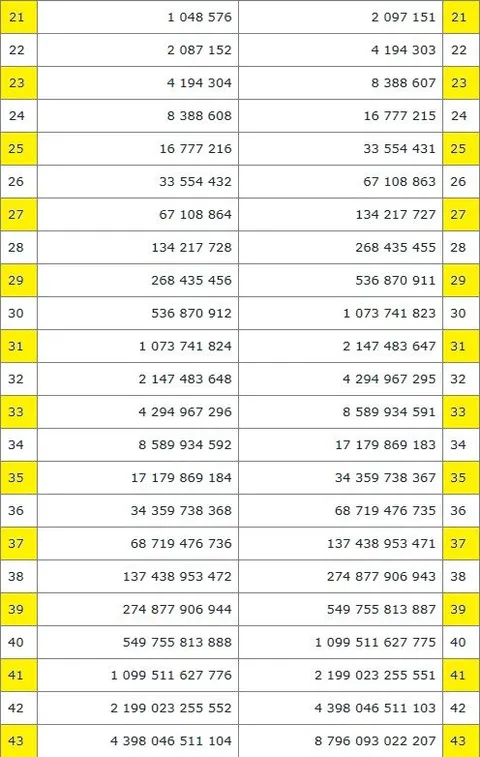
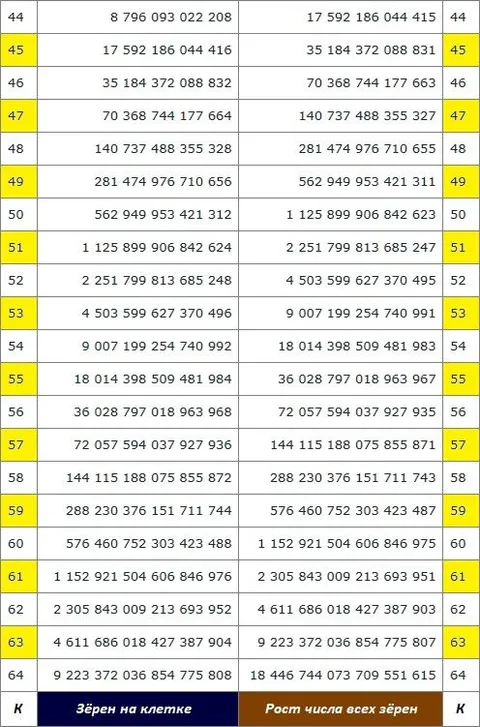
One of them is told by the great scholar Al-Biruni in his book “India”, which attributes the invention of chess to a certain Brahmin (a social group in India). For his invention he asked the raja for a reward that seemed insignificant at first sight: as many grains of wheat as there would be on the chessboard if one grain were placed on the first square, 2 grains on the second, 4 on the third, 8 on the fourth, 16 on the fifth, 32 on the sixth, and so on. It turned out that there was not that much grain on the whole planet (it equals 264 − 1 ≈ 1.845 × 10¹⁹ grains, enough to fill a storehouse with a volume of about 1,500 km³).
This is how the first legend goes
When the Indian raja Sheram became acquainted with the game, he was delighted by its ingenuity and the variety of positions possible in it. Learning that it had been invented by one of his subjects, the king ordered him summoned so that he could reward him personally for his clever invention.
The inventor, whose name was Sessa, appeared before his lord's throne. He was a modestly dressed scholar who earned his living from his pupils.
“I wish to reward you worthily, Sessa, for the wonderful game you have invented,” said the raja.
The sage bowed.
“I am rich enough to fulfil your boldest wish,” the raja continued. “Name a reward that will satisfy you, and you shall have it.”
Sessa was silent.
“Do not be shy,” the raja encouraged him. “Tell me your wish. I will spare nothing to fulfil it.”
“Great is your kindness, my lord. But give me time to consider my answer. Tomorrow, after careful thought, I will tell you my request.”
When Sessa came to the steps of the throne again the next day, he astonished the raja with the unparalleled modesty of his request.
“My lord,” said Sessa, “order that I be given one grain of wheat for the first square of the chessboard.”
“A simple grain of wheat?” the raja exclaimed in amazement.
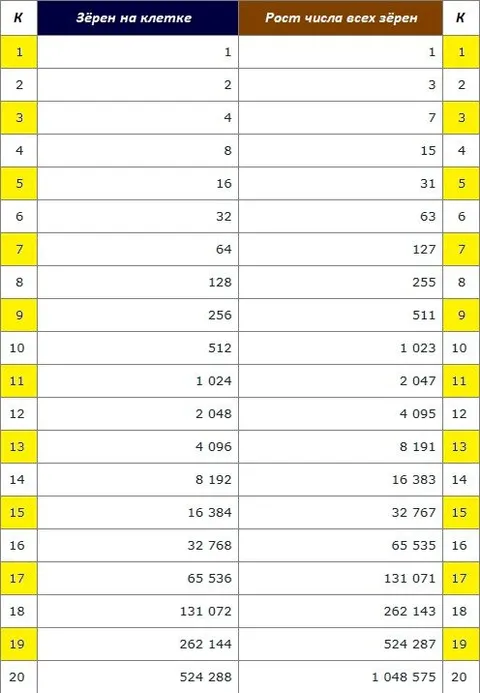
“Yes, my lord. For the second square order 2 grains, for the third 4, for the fourth 8, for the fifth 16, for the sixth 32…”
“Enough,” the raja interrupted him with irritation. “You shall have your grains for all 64 squares of the board, as you wish: for each square twice as many as for the one before. But know that your request is unworthy of my generosity. By asking for so paltry a reward you disrespectfully scorn my favour. Truly, as a teacher, you could set a better example of respect for your sovereign's kindness. Go. My servants will bring out your sack of wheat.”
Sessa smiled, left the hall and waited at the palace gates.
At dinner the raja remembered the inventor of chess and sent to find out whether reckless Sessa had already carried off his miserable reward.
“My lord,” came the answer, “your order is being carried out. The court mathematicians are calculating the number of grains due.” The raja frowned. He was not used to his orders being carried out so slowly.
In the evening, retiring for the night, the raja asked once more whether Sessa and his sack of wheat had long since left the palace grounds.
“My lord,” they answered, “your mathematicians are working tirelessly and hope to finish the count before dawn.”
“Why is this taking so long?” the raja cried angrily. “Tomorrow, before I wake, every last grain must be given to Sessa. I do not give an order twice.”
In the morning the raja was told that the eldest of the court mathematicians asked to make an important report. The raja ordered him brought in.
“Before you speak of your business,” Sheram declared, “I wish to hear whether Sessa has at last been given the paltry reward he chose for himself.”
“It is for that very reason that I dared to appear before you at so early an hour,” the old man replied. “We have conscientiously calculated the whole quantity of grain that Sessa wishes to receive. The number is so great…”
“However great it may be,” the raja interrupted haughtily, “my granaries will not run dry. The reward has been promised and must be given…”
“It is not in your power, my lord, to fulfil such wishes. In all your barns there is not as much grain as Sessa demanded. Nor is there in the granaries of the whole kingdom. Nor is there such a quantity of grain on the whole face of the Earth. And if you wish to give the promised reward without fail, then order the kingdoms of the earth turned into ploughland, order the seas and oceans drained, order the ice and snow that cover the distant northern deserts melted. Let all that space be sown with wheat, and order all that grows on those fields given to Sessa. Then he will receive his reward.” The king listened to the old man's words in amazement.
“Then tell me this monstrous number,” he said thoughtfully.
“Eighteen quintillion, four hundred and forty-six quadrillion, seven hundred and forty-four trillion, seventy-three billion, seven hundred and nine million, five hundred and fifty-one thousand, six hundred and fifteen, O my lord!”
So goes the legend. Whether what is told here really happened is unknown — but you can check for yourself by patient calculation that the reward in the legend really must be expressed by exactly this number. Starting with one, we must add up the numbers 1, 2, 4, 8 and so on. This sum can also be written as:
1 + 2 + 4 + 8 + … = 20 + 21 + 22 + 23 + … + 263.
The last term shows how much the inventor was due for the 64th square of the board.
Let us simplify this sum with the following reasoning. Denote
S = 20 + 21 + 22 + 23 + … + 263,
then
2S = 2 · (20 + 21 + 22 + 23 + … + 263) = 21 + 22 + 23 + 24 + … + 264
and
S = 2S – S = (21 + 22 + … + 264) – (20 + 21 + … + 263) = 264 – 20 = 264 – 1.
The required number of grains is
S = 264 – 1.
So the calculation comes down to multiplying 64 twos together! (Subtracting the one afterwards is easy.)
To make the arithmetic easier, split the 64 factors into 6 groups of 10 twos each and one last group of 4 twos. The product of 10 twos, as is easy to check, is 1,024, and of 4 twos, 16. So the result is
S = 1,024 · 1,024 · 1,024 · 1,024 · 1,024 · 1,024 · 16 – 1.
Since
1,024 · 1,024 = 1,048,576,
we have
S = 1,048,576 · 1,048,576 · 1,048,576 · 16 – 1.
With patience and care we get S = 18,446,744,073,709,551,615. This amount of grain is roughly 1,800 times the world's annual wheat harvest (in the 2008–2009 agricultural year it was 686 million tonnes) — more than all the wheat harvested in the whole history of humankind. In terms of mass: if one grain of wheat weighs 0.065 grams, the total wheat on the chessboard would be about 1,200 billion tonnes (18,446,744,073,709,551,615 × 0.065 g ≈ 1,199,038,364,791 t). Converted to volume (1 m³ of wheat weighs about 760 kg), that is roughly 1,500 km³, equivalent to a barn measuring 10 km × 10 km × 15 km — more than the entire volume of Mount Everest.
The Indian king was unable to pay such a reward. But had he been strong in mathematics, he could easily have freed himself from so burdensome a debt. All he had to do was invite Sessa to count out all the wheat due to him himself, grain by grain. Indeed, if Sessa had counted day and night without stopping, one grain per second, in the first day he would have counted only 86,400 grains. To count a million grains would take at least 10 days of tireless counting. He would count one cubic metre of wheat in about half a year — leaving another 1,499,999,999,999 m³ to go. You can see that even if he devoted the rest of his life to counting, Sessa would receive only a tiny fraction of the reward he had asked for.
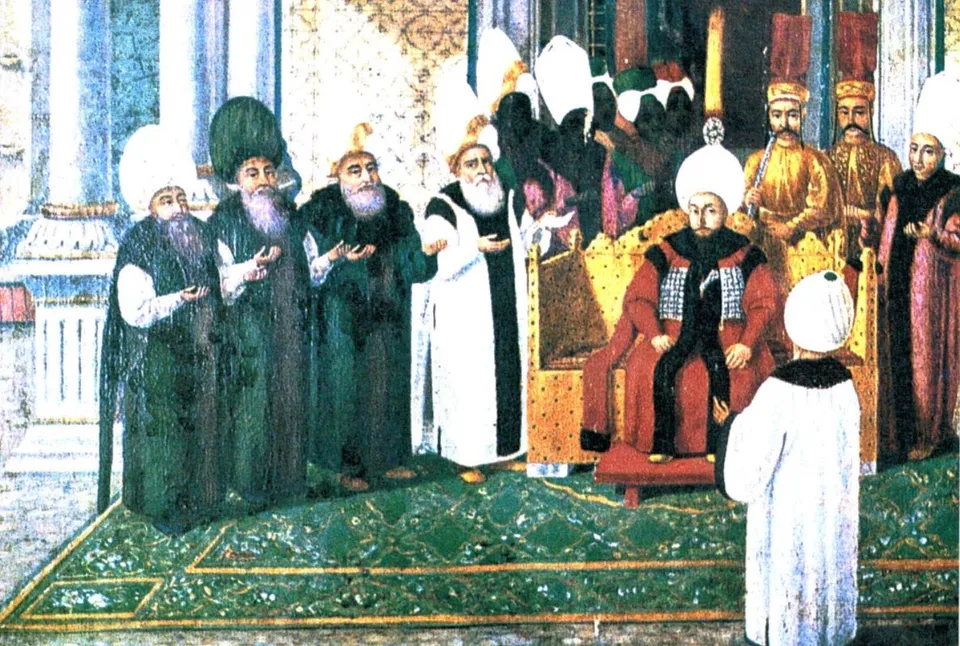
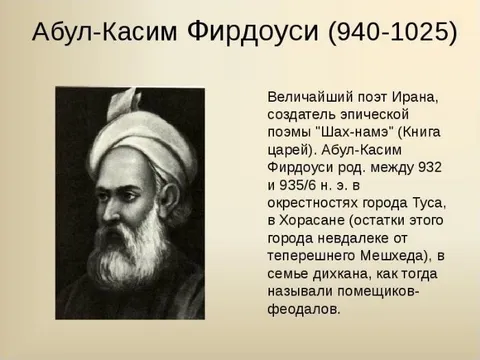
Another legend was found in the work of the Persian poet Ferdowsi, who wrote his epic about a thousand years ago. In an Indian kingdom there lived a queen and her twin sons, Gav and Talhand. When the time came for them to rule, their mother could not decide whom to make king, as she loved both sons equally. So the princes decided to fight a battle, and the winner would become ruler. They chose a battlefield on the seashore and surrounded it with a moat of water, so that there was nowhere to retreat. The condition was not to kill each other but to rout the opponent's army. The battle began, and Talhand perished in it. Learning of her son's death, the queen fell into despair. She reproached Gav, who had come to her, with killing his brother. But he answered that he had done his brother no bodily harm: Talhand had died of exhaustion. The queen asked to be told in detail how the battle had gone. Gav and his entourage decided to recreate the battlefield. They took a board, marked out squares and placed on it figures representing the warriors. The opposing armies were set on opposite sides in rows: infantry, cavalry, then infantry again. In the middle row, in the centre, stood the prince with his chief adviser beside him, and then pairs of elephants, camels, horses and Rukh birds. Moving the various figures, the prince showed his mother how the battle had gone. From this we can see that the ancient board had 100 squares and the pieces stood in three lines.
The next legend says that once, when India was a very powerful country, it was ruled by a king whose army's whole strength lay in specially trained war elephants. With their help he had already defeated all his enemies' armies and for many years did not know what to do with himself. One day he announced that whoever could invent something he liked would receive whatever he wished. Countless sages came to him from every country, bringing all kinds of beautiful things made only of gold or precious stones. But nothing they brought pleased the ruler. Then one day a poor Shah came to him with a small board and pieces, all made of wood. As soon as the ruler saw it he became terribly angry: “What is this? Everything I am shown is made of gold or jewels, and you come here with some bits of wood!” The Shah replied: “The interest of games lies not in gold but in wisdom.” At that moment the ruler noticed that the pieces looked like his own army. Intrigued, he agreed to look. The Shah showed him how to play, saying: “Your army is majestic and invincible, but can you win here, on a small board, with your troops against an opponent with the same army?” The ruler liked the game and was sure he would beat the Shah easily, but the Shah won the first game. The ruler tried again, now thinking over every move, and won the second game. After that he grew passionately fond of the game. Every time he attacked the enemy king he would say “shah”, warning that the king was in danger, and when he won he said “shah mat”, meaning “the king is dead”. Remembering his promise, the ruler asked the Shah what he wished, and the Shah named a reward that seemed small: one grain on the first square of the chessboard, two on the second, four on the third, and so on. But it turned out that there was not that much grain in the whole kingdom. History does not say how the ruler settled his debt with the Shah. But there is one more legend about how this wonderful game appeared.
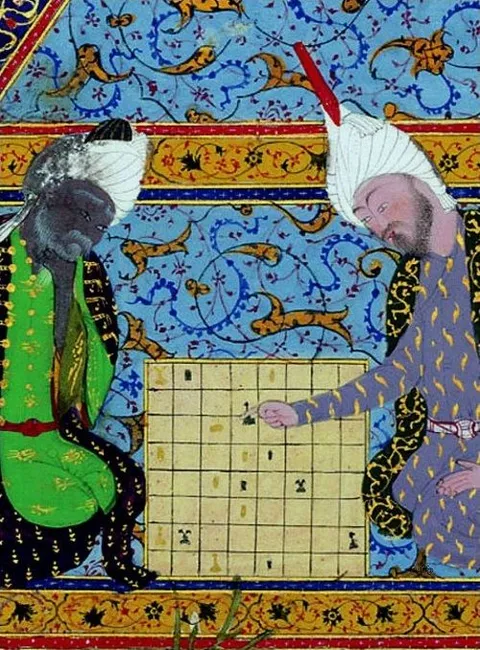
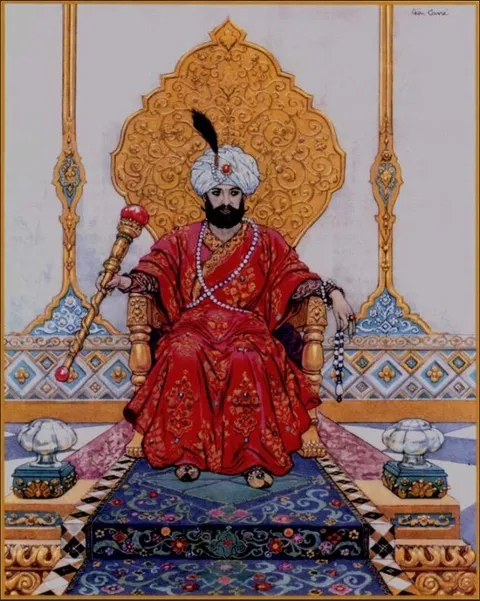
Once in India there was a very wise ruler. Under his rule the country flourished. He had two twin sons who differed only in that they liked to wear different clothes: one liked to dress in white, the other in black. Before his death the wise ruler could not decide which son to make king and divided the power equally between them. But soon each brother wanted there to be a single ruler, and each believed it should be himself. The brothers quarrelled, and a great war began in which very many people died. After a while the brothers understood that the war was endless, yet neither would stop it, because whoever ended the war would lose and not become ruler. Still, each brother wanted both to make peace and to find a way to become ruler. One day an old man came to them and said that if they ended the war, in which half of India had died, he would show them an honest way to decide who should rule. The brothers agreed. The old man took out a wooden board and black and white pieces, explained the rules, and a “war” lasting many days began, in which every move was carefully considered. The white pieces won that game — and since then White moves first in chess, and a great many people began to play.
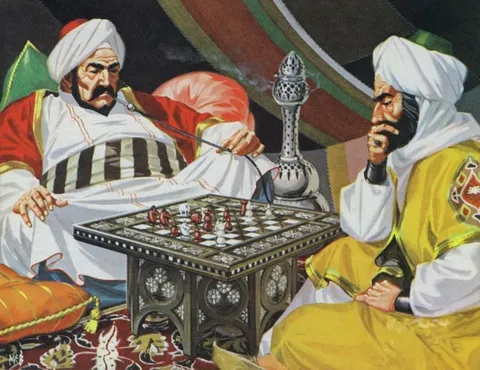
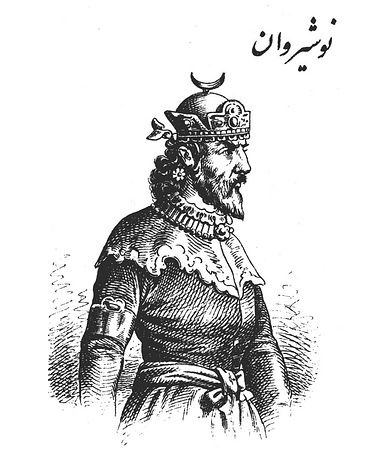
The first official mention of chess is a book describing in detail how chess came from India to Persia. With their gifts the Indians tried to win the favour of the Persian king Khosrow I Anushirvan (who ruled Iran from 531 to 579). The book describes absolutely everything about chess, paying special attention to terminology and to the powers of each piece. The next written document describing chess is a poem by the famous Persian poet Ferdowsi, in which he describes in detail a curious thing presented to the Persian king by the grateful Indian people: “a rather entertaining game”. Ferdowsi himself wrote that among the gifts brought to the Persian king was a game that reproduced a battle between two armies, black and white.
Persian chess players
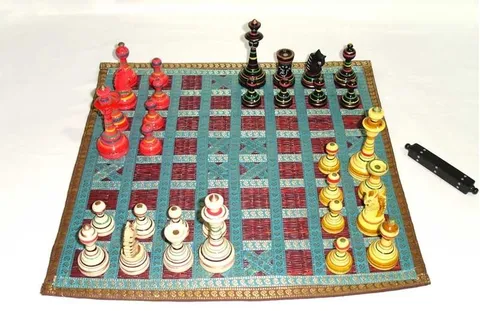
No later than the beginning of the 6th century, the first known game related to chess — chaturanga — appeared in north-western India. It already looked quite recognisably like chess (a square 8×8 board, 16 pieces and 16 pawns, similar pieces), but it differed fundamentally from modern chess in two ways: there were four players instead of two (playing in pairs), and moves were made according to throws of dice. Each player had four pieces (chariot (rook), horse, elephant, king) and four pawns. The horse and the king moved as in chess, the chariot up to two squares vertically or horizontally, and the elephant at first one square forwards or diagonally; later it began to “jump” one square diagonally and, like the knight, could leap over its own and enemy pieces. There was no queen at all. To win the game you had to destroy the opponents' entire army.
Arab transformations
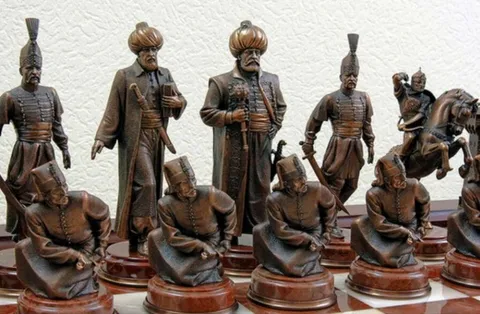
In the same 6th or perhaps 7th century chaturanga was adopted by the Arabs, and in the Arab East it was transformed: there were now two players, each commanding two sets of chaturanga pieces, and one of the kings became a counsellor (it moved one square diagonally). The dice were abandoned, and players moved strictly in turn, one move at a time. Victory was now achieved not by destroying all the opponent's pieces but by checkmate or stalemate, and also by finishing the game with king and at least one piece against a lone king (the last two options were necessary, since with the weak pieces inherited from chaturanga it was by no means always possible to give mate). The Arabs and Persians called the resulting game “shatranj”; the Buryat-Mongol version was called “shatar”. Later, among the Tajiks, shatranj received the Tajik name “shakhmat” (“the ruler is defeated”). The first mention of shatranj dates from around 550. In 600 came its first mention in literature — the Persian manuscript “Karnamak”. In 819, at the court of Caliph Al-Ma'mun in Khorasan, a tournament was held between the three strongest players of the time: Jabir al-Kufi, Abu'l-Jafar Ansari and Zairab Katai. In 847 the first chess book appeared, written by Al-Adli. Thanks to the abstract pieces, people gradually stopped seeing the game as a symbol of a military battle and increasingly associated it with the ups and downs of everyday life, which was reflected in epics and treatises devoted to chess (Omar Khayyam, Saadi, Nizami).
Chess in East Asia
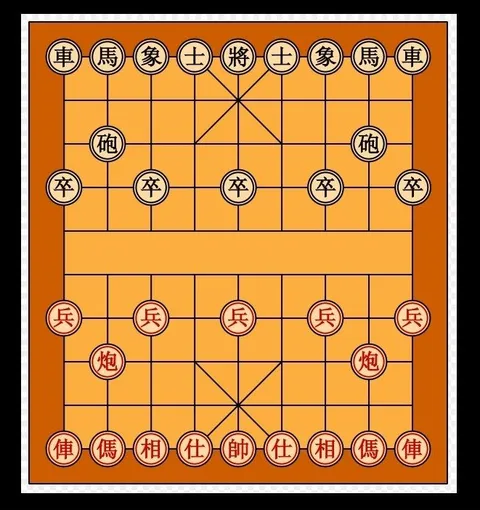
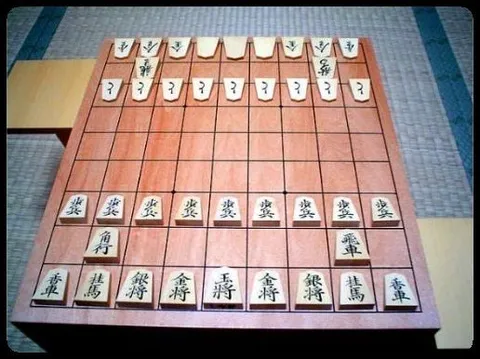
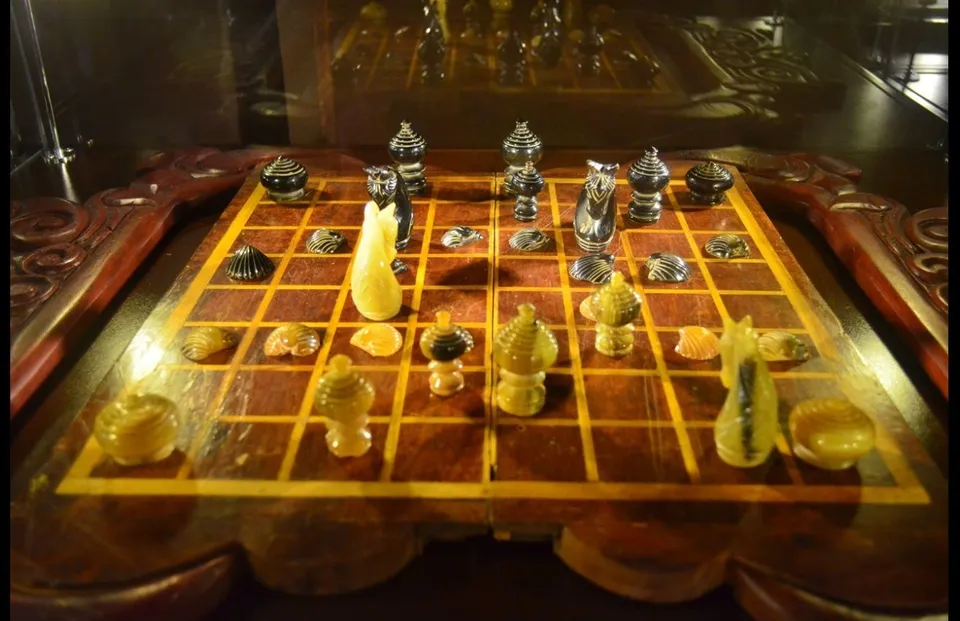
As chess moved west, it also spread east. Apparently the countries of South-East and East Asia received either the two-player version of chaturanga or one of the early versions of shatranj, since the chess games of this region kept their features: many pieces move only short distances, and there is no castling or en passant, which are typical of European chess. Influenced by the region's culture and its board games, the game changed noticeably in appearance and acquired new features, becoming the basis of the Chinese game xiangqi. From xiangqi in turn came the Korean game janggi. Both games are original in look and mechanics. Above all, the board size changed and the pieces are placed not on squares but on the intersections of lines. These games have pieces with a limited area of action that can move only within part of the board; the traditional “jumping” pieces became linear (neither the horse nor the elephant can jump over occupied points); and a new piece, the “cannon”, can capture enemy pieces only by jumping over another piece. The later Japanese variant, shogi, is considered a descendant of xiangqi but has its own features. The shogi board is simpler and more like the European one: pieces stand on squares, not intersections, and the board is 9×9. In shogi the moves changed and promotion appeared, which xiangqi did not have. The promotion mechanism is original: a piece (a flat token with a symbol on it) that reaches one of the last three ranks is simply turned over to show the symbol of the promoted piece. And the most interesting feature of shogi is that captured enemy pieces can, instead of a move, be dropped anywhere on the board (with some restrictions) as one's own. Because of this all shogi pieces are the same colour, and ownership is shown by direction — a player places a piece with its point towards the opponent. Classical European chess is not particularly widespread in this region; xiangqi and shogi are still far more popular.
Chess comes to Rus
Around 820, chess (more precisely, Arab shatranj under the Central Asian name “shakhmat”, which became “shakhmaty” in Russian) appeared in Rus, coming, it is believed, either directly from Persia via the Caucasus and the Khazar Khaganate, or from the peoples of Central Asia via Khwarezm. The Russian name of the game echoes the Central Asian “shakhmat”, and the Russian names of the pieces correspond most closely to the Arabic or Persian ones (“slon”, elephant, and “kon”, horse, are translations of the Arabic terms; “ferz” echoes the Persian “farzin” or Arabic “firzan”). According to one theory, the rook got its Russian name “ladya” (boat) because the corresponding Arab piece, the “rukh”, depicted a mythical bird and resembled a stylised Russian boat. A comparison of Russian chess terminology with that of the Transcaucasus, Mongolia and European countries shows that neither the name of the game nor the names of the pieces could have been borrowed from those regions, either in meaning or in sound. Changes in the rules later introduced by Europeans reached Rus with some delay, gradually turning old Russian chess into the modern game. It is believed that the European version of chess came to Russia in the 10th–11th centuries from Italy via Poland.
Chess reaches Europe
In the 8th–9th centuries, during the Arab conquest of Spain, shatranj came to Spain, and over the following decades to Portugal, Italy and France. The game quickly won Europeans' affection, and by the 11th century it was known in every country of Europe and Scandinavia. European masters continued to transform the rules, eventually turning shatranj into modern chess. By the 15th century chess had taken on, broadly speaking, its modern form, although because changes were not coordinated, different countries kept their own, sometimes quite peculiar, rules for several more centuries. In Italy, for example, until the 19th century a pawn reaching the last rank could only promote to a piece that had already been captured. Moving a pawn to the last rank when there were no such pieces was not forbidden; such a pawn remained a pawn and turned into the first piece the opponent captured, at the moment of capture. Italy also allowed castling with a piece between the rook and the king and with the king passing through an attacked square.
Chess in art
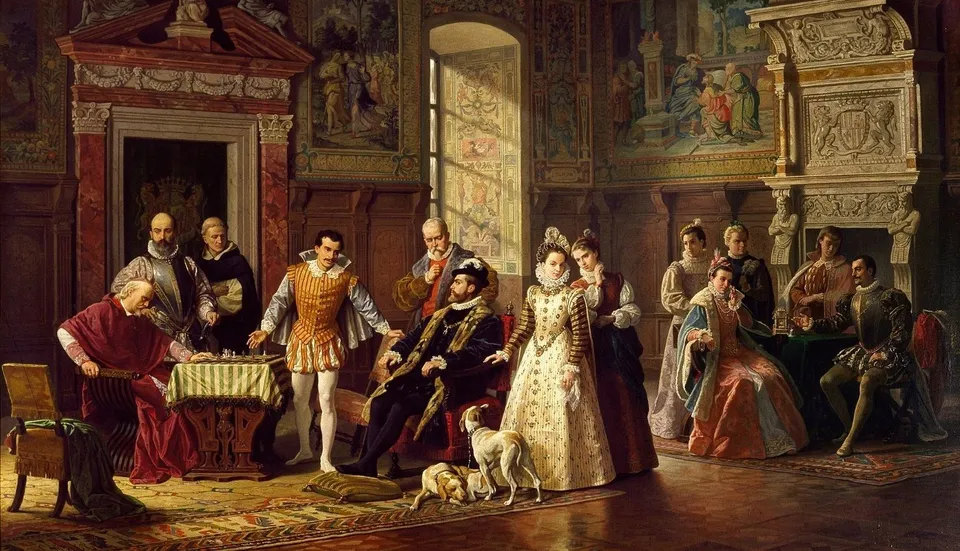
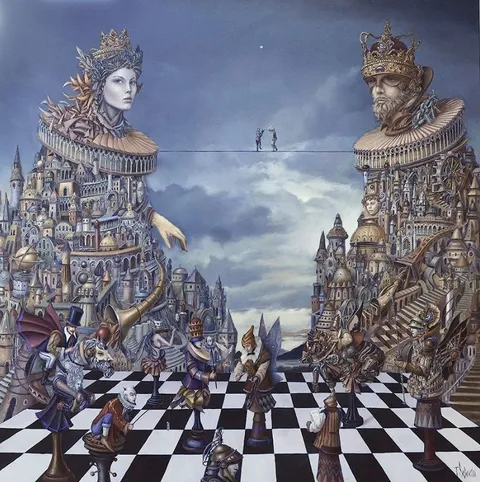
As chess spread in Europe, both chess works proper and works of art about the game began to appear. In 1160 the first chess poem appeared, written by Ibn Ezra. In 1283 came the first chess book in Europe, the treatise of Alfonso X the Wise. The book is of great historical interest, as it describes both the new European chess and the fading shatranj. From the 16th century chess books appeared more and more often, and chess constantly featured in works of art. In the 18th century chess acquired a patron muse. She was invented by the English poet William Jones, a great chess lover. He published a poem about the origin of chess in which Mars, the god of war, fell in love with the wood nymph Caissa; the nymph did not return his love, and to win her, Mars invented chess and taught Caissa to play. In general, the motif of the ancient gods playing chess was quite common in art.
The Christian Church against chess
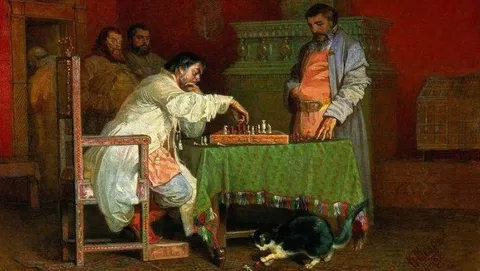
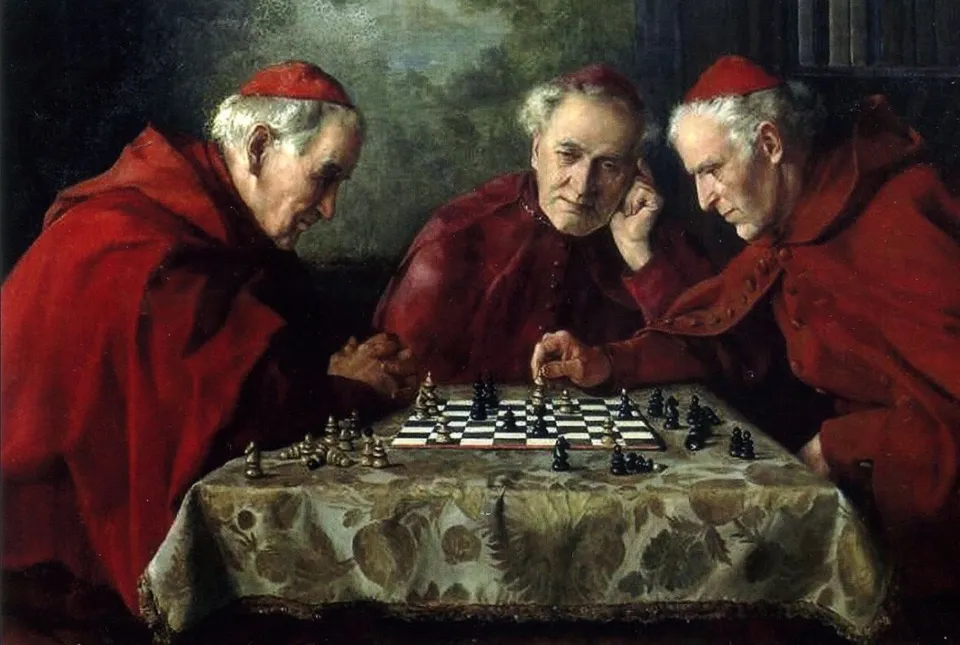
From the moment chess appeared, the Christian Church took a sharply negative view of it. Chess was equated with gambling and drunkenness — and, remarkably, the various branches of Christianity agreed on this. In 1061 the Catholic cardinal Damiani issued a decree forbidding the clergy to play chess. In a letter to Pope Alexander II he called chess “an invention of the devil”, “an indecent, unacceptable game”. Bernard, the founder of the Knights Templar, spoke in 1128 of the need to fight the passion for chess. In 1208 the French bishop Eudes de Sully forbade priests “to touch chess or keep it at home”. Jan Hus, the leader of the reformist wing of the Church, was also an opponent of chess. Under the influence of the Church, the game was banned by King Casimir II of Poland, Louis IX (Saint Louis) of France and Edward IV of England. In Rus the Orthodox Church also banned chess on pain of excommunication, which was officially recorded in the Kormchaya Kniga (book of canon law) of 1262. Despite the Church's bans, chess spread both in Europe and in Russia, and the clergy were no less (if not more) fond of the game than other classes. At the Nerevsky excavation in Novgorod alone, archaeologists found many chess pieces in layers from the 13th–15th centuries, and in the 15th-century layer chess pieces turn up in almost every excavated homestead. In 2010 a chess king was found in a 14th–15th-century layer in the Novgorod Kremlin, next to the archbishop's residence. In Europe, the Council of Regensburg in 1393 removed chess from the list of forbidden games. In Russia there is no record of an official lifting of the Church's ban, but at least from the 17th–18th centuries it was effectively not enforced. Ivan the Terrible played chess (according to tradition, he even died at the chessboard). Under Alexei Mikhailovich chess was widespread among courtiers, and the ability to play was common among diplomats. European documents of the time survive saying, in particular, that Russian envoys knew chess and played it very well. Tsarevna Sofia was fond of chess, and under Peter I no assembly took place without chess.
The development of chess theory
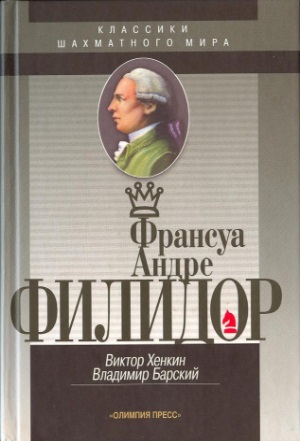
By the 15th–16th centuries the rules of chess had largely settled, which allowed systematic chess theory to develop. In 1561 Ruy López published the first complete chess textbook, which examined the stages of the game we distinguish today — opening, middlegame and endgame. He was also the first to describe a characteristic type of opening, the “gambit”, in which an advantage in development is gained by sacrificing material. In the 18th century Philidor made a great contribution to chess theory. He seriously revised the views of his predecessors, above all the Italian masters, who believed that the best style was a massive attack on the enemy king with all available forces and who used pawns only as auxiliary material. Philidor developed what is now called the positional style. He believed that a player should not throw himself into reckless attacks but should systematically build a strong, stable position, strike precisely calculated blows at the weaknesses of the opponent's position, and, when necessary, resort to exchanges and simplifications if they lead to a favourable endgame. A correct position, according to Philidor, is above all a correct arrangement of pawns. In his words, “Pawns are the soul of chess.” Philidor worked out the tactics of advancing a pawn chain, insisted on the importance of the pawn centre and analysed the fight for the centre. Many of his ideas formed the basis of chess theory in the following century. Philidor's book “Analysis of the Game of Chess” became a classic: it went through 42 editions in the 18th century alone and was reprinted many times later.
Chess in the 19th and 20th centuries
From the 16th century chess clubs began to appear, where amateurs and semi-professionals gathered, often playing for money. Over the next two centuries the spread of chess led to national tournaments in most European countries. Chess publications appeared, at first isolated and irregular, but over time increasingly popular. The first chess magazine, “Le Palamède”, was started in 1836 by the French player Louis-Charles de La Bourdonnais. A chess magazine appeared in Great Britain in 1837 and in Germany in 1846.
In the 19th century international matches (from 1821) and tournaments (from 1851) began to be held. The first such tournament, in London in 1851, was won by Adolf Anderssen. He became the unofficial “king of chess”, that is, the player considered the strongest in the world. The title was later challenged by Paul Morphy (USA), who won their 1858 match +7 −2 =2, but after Morphy left the chess scene in 1859 Anderssen was again the first, and in 1866 Wilhelm Steinitz beat Anderssen in a match +8 −6 and became the new “uncrowned king”.
The first world chess champion officially to hold the title was that same Wilhelm Steinitz, who defeated Johannes Zukertort in the first match in history whose agreement used the phrase “match for the championship of the world”. Thus a system of succession took shape by custom: the new world champion was whoever won a match against the previous one, while the reigning champion kept the right to accept or reject a challenger and himself set the terms and venue of the match. The only mechanism that could force the champion to play a challenger was public opinion: if a generally recognised strong player could not for a long time obtain a match with the champion, this was seen as a sign of the champion's cowardice, and to save face he had to accept the challenge. As a rule, the match agreement gave the champion the right to a return match if he lost; winning such a match returned the title to its previous holder.
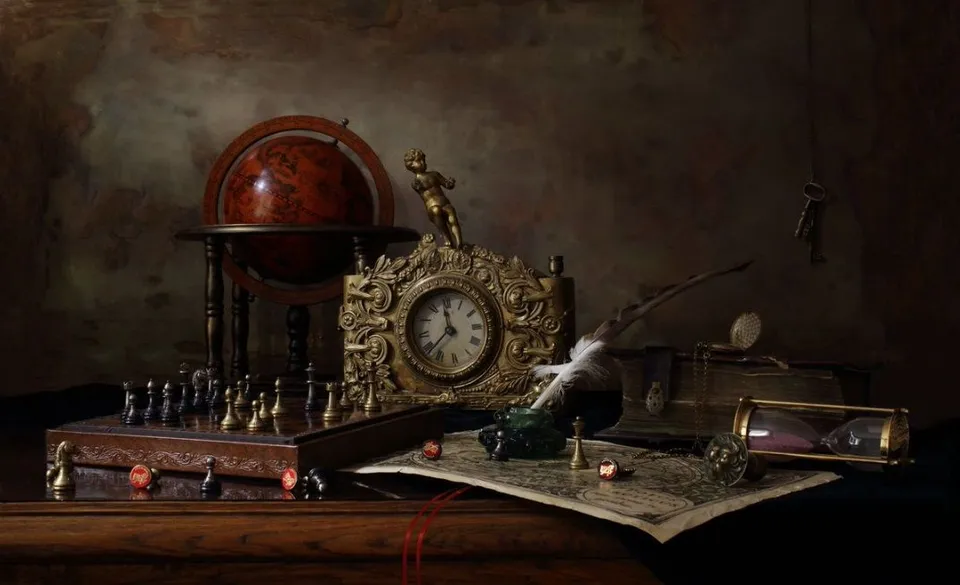
In the second half of the 19th century time controls began to be used in chess tournaments. At first ordinary hourglasses were used (limiting the time per move), which was rather inconvenient, but soon the English amateur Thomas Bright Wilson invented special chess clocks that made it easy to limit the time for the whole game or for a certain number of moves. Time controls quickly became part of chess practice and were soon used everywhere. By the end of the 19th century official tournaments and matches without time controls were practically no longer held. Together with time controls came the notion of “time trouble”. Time controls also made possible special forms of tournament with greatly shortened limits: “rapid chess”, with about 30 minutes per player for the game, and “blitz”, with 5–10 minutes. These became widespread much later, however.
Chess becomes an international sport
In the late 19th and early 20th centuries chess developed very actively in Europe and America: chess organisations grew larger, and more and more international tournaments were held. In 1924 the International Chess Federation (FIDE) was founded, initially to organise the Chess Olympiads.
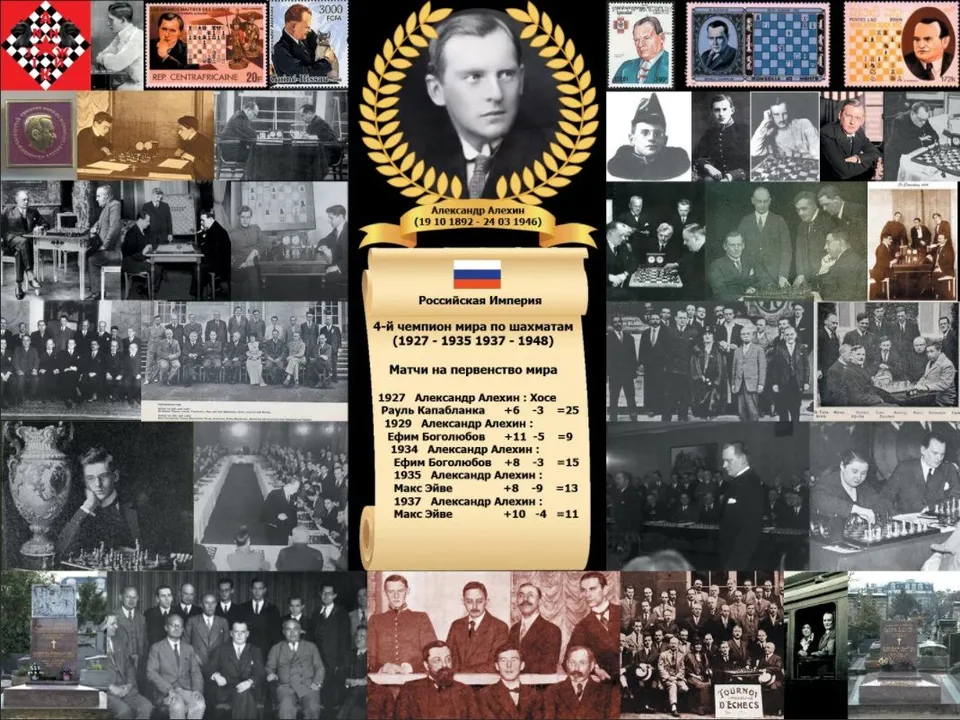
Until 1948 the 19th-century system of succession to the world title remained: a challenger called the champion to a match, and the winner became the new champion. Emanuel Lasker (the second official world champion after Steinitz, who won the title in 1894) remained champion until 1921, José Raúl Capablanca from 1921 to 1927, and Alexander Alekhine from 1927 to 1946 (in 1935 Alekhine lost the world championship match to Max Euwe, but in 1937 he regained the title in a return match and held it until his death in 1946).
After the death in 1946 of Alekhine, who remained undefeated, FIDE took over the organisation of the world championship. The first official FIDE world chess championship was held in 1948 and won by the Soviet grandmaster Mikhail Botvinnik. FIDE introduced a system of tournaments for winning the title: winners of qualifying stages went on to zonal tournaments, winners of zonal events to the Interzonal, and the best finishers there took part in the Candidates, where a series of knockout matches determined the winner, who then played a match against the reigning champion. The formula of the title match has changed several times. Today, the champion's challenger is determined by the Candidates tournament, which brings together qualifiers from several events and the highest-rated players.
The Soviet chess school played a huge role in the history of chess, especially in the second half of the 20th century. The wide popularity of chess, active and purposeful teaching, and the identification of talented players from childhood (every city in the USSR had a chess section or children's chess school; there were chess clubs at schools, enterprises and organisations; tournaments were held constantly; a great deal of specialised literature was published) contributed to the high level of Soviet players. Chess received attention at the very highest level. As a result, from the late 1940s until the collapse of the USSR Soviet players dominated world chess almost completely. Of the 21 Chess Olympiads held from 1950 to 1990, the USSR team won 18 and took silver in one more; of the 14 women's Olympiads in the same period it won 11 and took silver twice. Of 18 men's world championship contests over 40 years, only once was the winner not a Soviet player (it was the American Robert Fischer), and only twice more was the challenger not from the USSR (and that challenger, Viktor Korchnoi, who had defected from the USSR to the West, was himself a product of the Soviet chess school).
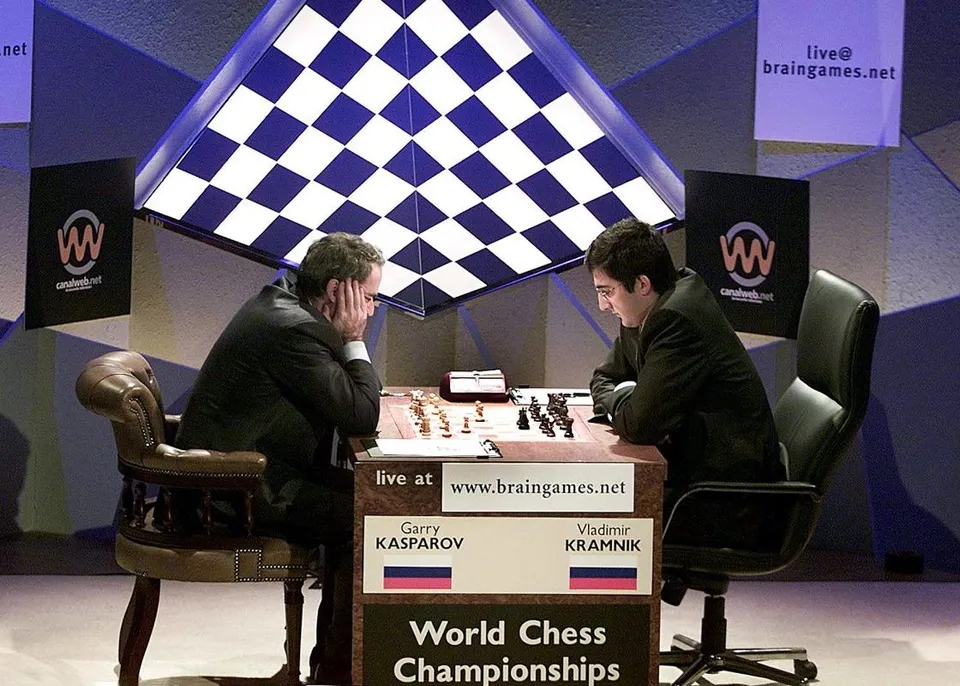
In 1993 Garry Kasparov, then world champion, and Nigel Short, winner of the qualifying cycle, refused to play their world championship match under FIDE's auspices, accusing the federation's leadership of unprofessionalism and corruption. Kasparov and Short founded a new organisation, the PCA (Professional Chess Association), and played the match under its auspices.
The chess movement split. FIDE stripped Kasparov of the title, and the FIDE world championship was contested between Anatoly Karpov and Jan Timman, who at the time had the highest ratings after Kasparov and Short. Meanwhile Kasparov continued to regard himself as the “real” world champion, since he had defended the title against the legitimate challenger, Short, and part of the chess community stood with him. In 1996 the PCA ceased to exist after losing its sponsor, and its champions came to be called “classical world chess champions”. In essence, Kasparov revived the old system of passing on the title, in which the champion himself accepted a challenge and played a match. The next “classical” champion was Vladimir Kramnik, who beat Kasparov in 2000 and defended the title against Péter Lékó in 2004. Until 1998 FIDE continued to hold its championship in the traditional way (Anatoly Karpov remained FIDE champion in this period), but from 1999 to 2004 the format changed drastically: instead of a challenger–champion match, the title was contested in a knockout tournament in which the reigning champion took part on equal terms. As a result the title constantly changed hands, with five champions in six years.
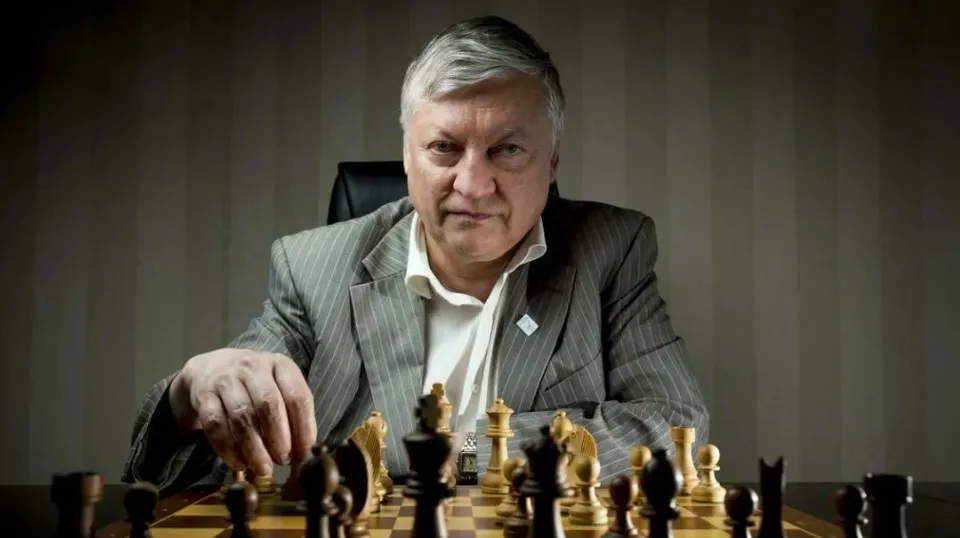
In general, in the 1990s FIDE made a number of attempts to make chess competitions more dynamic and interesting, and so more attractive to potential sponsors. Above all, some events switched from the Swiss or round-robin system to knockout (each round a short elimination match). Because a knockout requires a definite result in each round, tournament regulations introduced extra rapid and even blitz games: if the main series of games with a normal time control ends in a draw, an extra game with a shorter time control is played. More complex time controls protecting against severe time trouble came into use, in particular the “Fischer clock” — a time control with an increment added after each move.
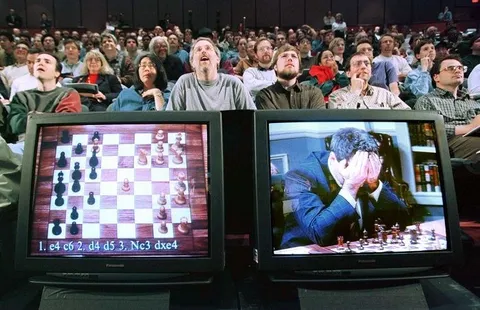
The last decade of the 20th century brought another important event: computer chess reached a level high enough to surpass human players. In 1996 Garry Kasparov lost a game to a computer for the first time, and in 1997 he lost a match to the computer Deep Blue by one point. The explosive growth of computer speed and memory, combined with better algorithms, meant that by the start of the 21st century there were widely available programs able to play in real time at grandmaster level. Connecting them to pre-built opening databases and endgame tablebases makes the machine stronger still. As a result the format of top-level competitions changed: tournaments introduced special measures against computer assistance and completely abandoned adjourned games. The time per game also shrank: while in the mid-20th century the norm was 2.5 hours for 40 moves, by the end of the century it had fallen to 2 hours (sometimes even 100 minutes) for 40 moves.
Chess today
After the 2006 reunification match Kramnik — Topalov, FIDE's monopoly on holding the world championship and awarding the title of world chess champion was restored. The first “unified” world champion was Vladimir Kramnik (Russia), who won that match.
Viswanathan Anand defeated Vladimir Kramnik in the 2007 world championship. In 2008 a return match between Anand and Kramnik was held, and Anand kept his title.
Viswanathan Anand defended the title in May 2010 in a match against the Bulgarian challenger Veselin Topalov (6.5:5.5) and in May 2012 against the Israeli challenger Boris Gelfand (6:6 in the main match; 2.5:1.5 in the tie-break).
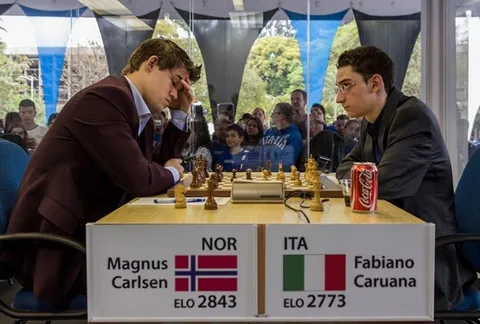
In 2013 Viswanathan Anand lost the match in Chennai and ceded the title to the Norwegian challenger Magnus Carlsen. In 2014 in Sochi Magnus Carlsen defended the title against Viswanathan Anand, and in 2016 in New York against Sergey Karjakin. In 2018 in London Magnus Carlsen defended his title for the third time, against Fabiano Caruana, and in 2021 in Dubai against Ian Nepomniachtchi. In 2023 Carlsen declined to defend the title; it was won by Ding Liren, who lost it in 2024 to the young Indian Gukesh Dommaraju.
FIDE adjusts the formula for contesting the title from time to time, but today the classical format is back: the challenger is determined by the Candidates tournament and then plays a match against the reigning champion.
Living chess
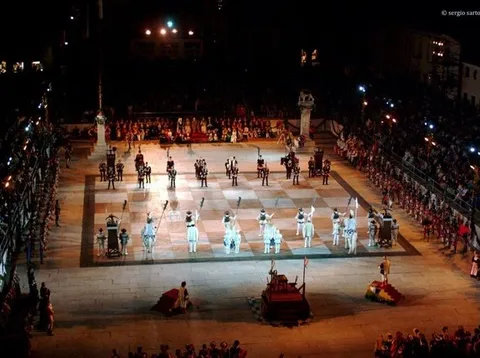
When the game of chess took on its finished form, so-called “living chess” came into fashion — theatrical performances held on large open spaces marked out like a chessboard. The first mention of “living chess” dates from 1408, when a chess performance that amazed many was held for the first time at the court of Sultan Muhammad, ruler of Granada.
“Living chess” has not lost its popularity today. For example, every two years the Italian town of Marostica holds such a performance with the townspeople taking part. And in London, inspired by “living chess”, the Spanish designer Jaime Hayon placed huge chess pieces in Trafalgar Square as part of the London Design Festival.
The benefits of playing chess
Chess has long been a sport. But that does not stop millions of people from playing simply for the joy of the game. Chess is the most fascinating intellectual game. Specialists have found that chess is enormously good for the brain, since during play a person uses both hemispheres at once. Chess battles help develop logical thinking and short- and long-term memory. They teach us to anticipate events and make the right decisions.

Knowing the rules and the basics of strategy is only the beginning — there is so much to learn in chess that a whole lifetime is not enough to learn it all!
You need to do two things:
– Play
Just keep playing! Play as much as you can. Learn a lesson from every game — the ones you lose and the ones you win.
– Study
If you really want to improve quickly, get some chess books. Read more and feel like a great chess player. There are also many resources here on the Check & Mate website to help you learn and improve your game.